

New research has emerged on the escalating heat in Europe and its growing impacts. With Europe heating up twice as fast as the global average, Spain-based researchers have suggested implementing an emergency alert system to warn vulnerable people, especially the elderly, ahead of dangerous heatwaves.
According to a study published in the journal Nature Medicine, “Europe experienced an exceptionally deadly summer in 2024 with more than 60,000 heat-related deaths, bringing the total burden over the past three summers to more than 181,000.” Researchers at the Barcelona Institute for Global Health (ISGlobal) reached this figure by analyzing mortality data from regions across 32 European countries, covering a population of 539 million. The death toll during last year’s summer, which was the hottest on record for both Europe and the world, was estimated at 62,775. This was nearly 25% higher than the 50,798 estimated for the summer of 2023 but remained below the 2022 toll of 67,873. The study’s lead author, Tomas Janos, noted that these numbers are not “ultimate and precise” due to inherent uncertainties in this type of research.
Accounting for this uncertainty, the 2024 study provided a wider estimate range of 35,000 to 85,000 deaths. It’s challenging to determine the exact number of heat-related deaths because heat is very rarely listed as an official cause of death. Beyond immediate effects like heatstroke and dehydration, heat contributes to a wide range of potentially fatal health issues, including heart attacks, strokes, and respiratory conditions. The study found that Italy had the most heat-related deaths last summer, with an estimated 19,000, followed by Spain and Germany, both with over 6,000. When adjusted for population size, Greece had the highest rate with 574 deaths per million people, followed by Bulgaria and Serbia.
Glacier Melting
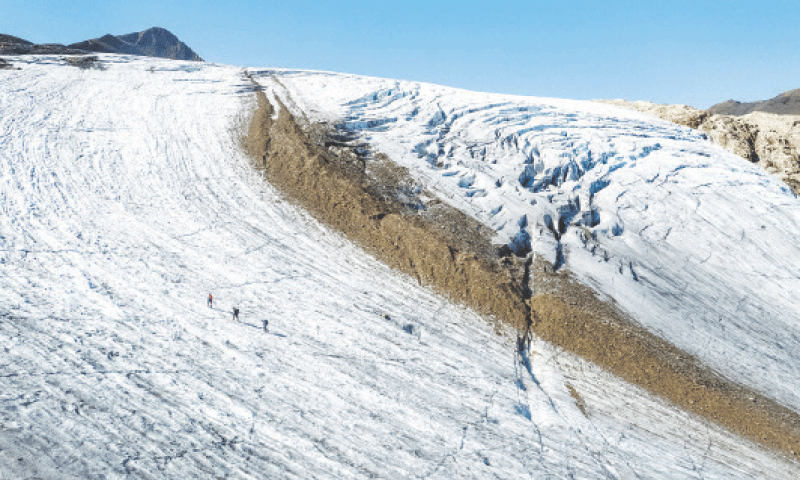
The head of the Tarfala Research Station in northern Sweden announced on Monday that eight of Sweden’s 277 glaciers have completely melted in 2024 due to global warming and are now extinct. Glaciology Professor Nina Kirchner added that another 30 glaciers are at risk. She stated that the extinct glaciers “won’t come back in our lifetime and not if global warming continues.” Kirchner and her colleagues annually study satellite images of the country’s glaciers to track their changes.
“At the beginning of 2025, when we sat down to do our 2024 update to see when the glaciers were at their smallest, we couldn’t find eight of the glaciers on the satellite images,” she said. “At first we thought we had done something wrong or missed something.” After double-checking their data, the group concluded that “the eight are gone.” Among the eight was Sweden’s northernmost glacier, Cunujokeln in the Vadvetjakka national park.
