

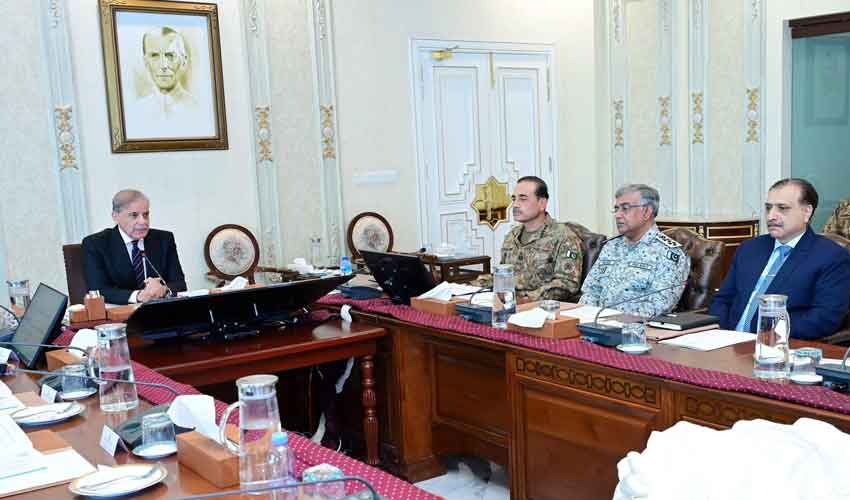
On Monday, Prime Minister Shehbaz Sharif chaired a high-level meeting of the National Security Committee (NSC). The meeting focused on reviewing the regional security landscape following the Iran-Israel conflict and subsequent US strikes on Iranian territory, as reported by informed sources. Held at the Prime Minister House, the gathering saw the participation of the Chairman Joint Chiefs of Staff Committee, the chiefs of the Pakistan Army, Navy, and Air Force, alongside senior federal ministers and top intelligence officials. Also in attendance were Defense Minister Khawaja Asif, Interior Minister Mohsin Naqvi, Finance Minister Muhammad Aurangzeb, and former Interior Minister Rana Sanaullah.
Strong Condemnation of US Strikes on Iran and Calls for Regional Peace
The National Security Committee strongly condemned the June 22 US airstrikes on Iran’s nuclear facilities in Fordow, Natanz, and Isfahan. The committee unequivocally termed these attacks a blatant violation of the United Nations Charter, international laws, and IAEA resolutions. According to an official statement, the country’s political and military leadership thoroughly reviewed the rapidly evolving situation in the Middle East. They voiced profound concern over the escalating tensions stemming from the Israeli aggression against Iran, affirming Iran’s inherent right to self-defense in accordance with the UN Charter.
The committee reiterated Pakistan’s clear and consistent position on the Middle East crisis, reaffirming its unwavering commitment to supporting peace and stability in the region. It lauded the country’s diplomatic endeavors aimed at preventing further escalation and pledged to continue engaging with all relevant parties. The NSC cautioned that irresponsible actions could trigger a wider and more perilous conflict in the region.
The committee expressed deep regret that these attacks transpired during a period when constructive dialogue between Iran and the United States was reportedly underway. The statement highlighted, “These reckless actions have derailed the diplomatic process, increased the risk of large-scale conflict, and undermined the prospects for peaceful resolution.”
Emphasizing the paramount importance of peaceful dialogue, the committee urged all sides to resolve their disputes through negotiations and diplomatic channels, strictly adhering to the principles of the United Nations Charter. The committee also called for full compliance with international human rights and humanitarian law. The NSC conveyed its deep sympathy to the government and people of Iran over the tragic loss of innocent lives and condemned the targeting of nuclear sites, labeling it a flagrant violation of the UN Charter and IAEA regulations.
Pakistan’s Security Posture and Regional Concerns
Furthermore, sources indicated that Chief of Army Staff Field Marshal Asim Munir briefed the attendees on his recent visit to the United States. He took the civil-military leadership into confidence regarding Pakistan’s security engagements and strategic outlook. Sources further disclosed that the meeting included a detailed briefing on Pakistan’s recent diplomatic efforts, spearheaded by former foreign minister Bilawal Bhutto Zardari, aimed at fostering regional peace and stability. The committee also expressed serious concern regarding threats related to “India’s water aggression,” with sources revealing that Pakistani forces are closely monitoring Indian movements in this regard.
The NSC reaffirmed Pakistan’s resolute commitment to counter any provocative actions and reiterated its unwavering dedication to safeguarding national interests at all costs. A source privy to the meeting’s proceedings stated, “The National Security Committee remains vigilant and fully prepared to thwart any nefarious designs against Pakistan.” The committee vowed to continue its diplomatic efforts to avert a large-scale war in the region.
