

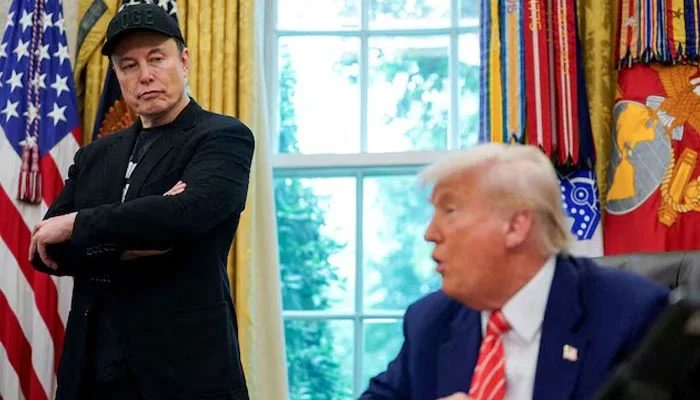
Musk’s announcement of the “America Party” came shortly after President Trump signed a major domestic policy bill into law. Musk has publicly criticized this bill, asserting that it will significantly inflate the national deficit. While the Tesla founder has yet to provide extensive policy details, he is expected to target specific House and Senate seats in the 2026 midterms. His focus will likely be on Republican incumbents who supported Trump’s bill despite having previously advocated for fiscal responsibility.
Political analyst Matt Shoemaker believes Musk’s “America Party” could be a “wild card that could upend the midterms in 2026, particularly for Republicans.” Given that Republicans currently hold a 220-215 majority in the House and a 53-47 majority in the Senate, Shoemaker suggests they “should be worried.”
Musk, who is considered the world’s richest person, had hinted at forming a new party for weeks. A social media poll he conducted in June garnered 80% support among 5.6 million respondents for the creation of a new political party. Unlike most third parties, Musk’s venture would possess almost limitless financial resources. Furthermore, his considerable following, particularly among young American men who view him as a “maverick genius,” could serve as a significant asset. Shoemaker notes that “Musk’s brand appeals to disaffected independents and younger, tech-savvy voters who might otherwise break for Republicans in swing districts.”
Challenges and Historical Context for Third Parties
Despite his immense wealth—he reportedly spent $277 million on Trump’s 2024 campaign—Musk’s political influence has seen mixed results. A recent venture in Wisconsin, where he spent $20 million on a state supreme court candidate who lost, highlighted the limitations of wealth and celebrity in politics. There’s also the inherent difficulty of building support in the American heartland, beyond the tech-savvy demographic often associated with Silicon Valley.
Musk’s public favorability has reportedly declined since his involvement with the Trump administration. According to pollster Nate Silver, Musk’s net favorability stands at -18.1, which is lower than Trump’s -6.6. Political science associate professor Flavio Hickel from Washington College suggests that the Republican base and the “MAGA movement” are “fairly inseparable” and their support for Trump has been “unwavering.” This makes it “hard to imagine any political project associated with Musk siphoning off votes from individuals who approve of [Donald] Trump.”
Historically, third parties in the US have faced significant challenges. In modern US history, wins for third parties have been rare. The Conservative Party of New York State in the 1970s and the Farmer-Labour Party in the 1930s are notable exceptions, having won Senate seats in the last century. While smaller parties saw some success in the House in the early 20th century, they’ve only secured one seat since the 1950s.
Analysts point to numerous hurdles for third-party candidates attempting to get on the ballot, including minimum signature requirements, filing fees, and other state-specific regulations concerning age, residency, and citizenship. Veteran political strategist Matt Klink recalled the “No Labels” party from early 2024, which “fizzled out in epic fashion.”
While winning congressional seats might be a stretch, analysts agree that Musk’s party could still impact Republicans. Evan Nierman, CEO of Red Banyan, a global crisis PR firm, stated, “Musk’s party won’t win seats, but it could cost Republicans plenty.” He added that “In tight districts, even a few points siphoned off from the right could flip control.” This suggests that even without direct victories, the “America Party” could play a spoiler role, making it more challenging for Republicans to maintain their slim majorities.
