

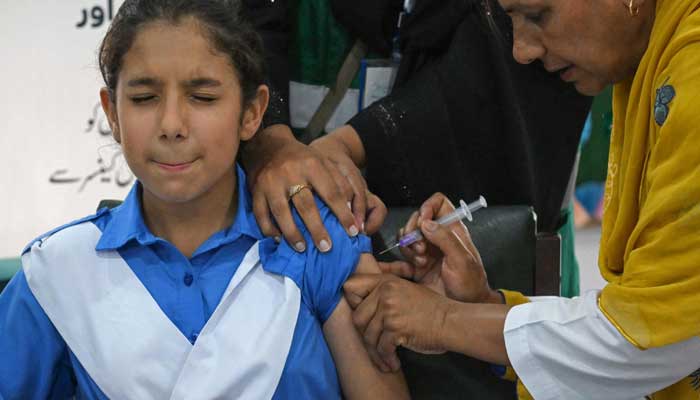
Misinformation severely hampered the initial rollout of a vaccine intended to protect Pakistani girls against cervical cancer, resulting in parents refusing to open their doors to healthcare workers and some schools briefly closing over false claims that the jab causes infertility.
The nation’s inaugural HPV vaccine campaign had an ambitious goal of administering doses to million girls, yet by the time it concluded on Saturday, only approximately half of the intended doses had been given.
The Spread of Conspiracy Theories
A long-standing conspiracy theory suggesting that Western-produced vaccines are used as a means of population control has been widely circulating online within Pakistan. Furthermore, false information spread claiming the vaccine disrupts the hormones of young girls.
“Some people have refused, closed their gates on us, and even concealed information about their daughter’s age,” vaccinator Ambreen Zehra told AFP while conducting door-to-door outreach in a lower-middle-income neighborhood in Karachi.
An anonymous federal health department official confirmed to AFP that only around half of the targeted vaccines had been administered. “Many girls we aimed to reach are still unvaccinated, but we are committed to ensuring the vaccine remains available even after the campaign concludes so that more women and girls get vaccinated,” the official stated on Friday.
An anonymous teacher on the outskirts of Rawalpindi informed AFP that not a single vaccine had been given in her school because parents withheld consent, a situation she noted was common in other rural schools. Another health official, who requested anonymity, added that some private schools had gone so far as to close for several days to actively avoid vaccine workers.
Syeda Rashida Batool, Islamabad’s top health official, who started the campaign by inoculating her own daughter, recounted the early days: “On the first day we reached of our target, it was not good, but it was fine.” She added, “The evening of that first day, videos started circulating online, and after that, it dipped. It all changed.“
A video showing schoolgirls doubled over in pain—a result of teargas wafting into their classroom during a protest several years ago—was deliberately re-shared online, falsely alleging it demonstrated the adverse after-effects of the vaccine. Rashid Mehmood Soomro, the popular leader of a right-wing party, claimed last week that the voluntary vaccine was being forced onto girls by the government. Speaking at a rally in Karachi, he asserted, “In reality, our daughters are being made infertile.“
Cervical Cancer Risk and Cultural Barriers
In of cases, cervical cancer is caused by persistent infection with Human Papillomavirus (HPV)—a virus transmitted through sexual activity, including non-penetrative sex.
The HPV vaccine, which is fully approved by the World Health Organisation (WHO), is a safe, scientifically proven defense against cervical cancer and has a well-established history of saving lives in over countries.
Cervical cancer is exceptionally deadly in low and middle-income countries like Pakistan, where UNICEF reports that roughly two-thirds of the estimated women diagnosed annually will die, though the true figure is likely under-reported. This high mortality is primarily due to a significant lack of disease awareness, cultural taboos surrounding sexual health, and poor screening and treatment facilities. The problem is compounded by the damaging false belief that only women with multiple sexual partners can contract sexually transmitted infections.
In Europe, where HPV vaccination rates have been high, there were approximately cervical cancer diagnoses across all EU nations in , with about one-third of those women succumbing to the disease, according to the European Commission.
Maryam Bibi, a -year-old mother in Karachi, told AFP that her husband would not permit the vaccination of her three daughters. She stated, “It is being said that this vaccine will make children infertile. This will control the population.” Humna Saleem, a -year-old housewife in Lahore, found the vaccine to be “unnecessary.” She told AFP, “All cancers are terrible. Why don’t we tell our boys to be loyal to their wives instead of telling our girls to get more vaccines?”
Pakistan—which, along with Afghanistan, is one of only two countries where polio is endemic—continues to struggle with vaccine acceptance due to deeply entrenched misinformation and conspiracy theories. After achieving the milestone of one year without any polio cases in , the crippling disease has sadly resurged with cases reported in so far.
In a direct effort to counter the overwhelming misinformation surrounding the HPV vaccine, Federal Health Minister Mustafa Kamal took the notable step of having his teenage daughter publicly vaccinated in front of television cameras. “In my -year political career, I have never made my family public,” he told reporters. “But the way my daughter is dear to me, the nation’s daughters are also dear to me, so I brought her in front of the media.”
