

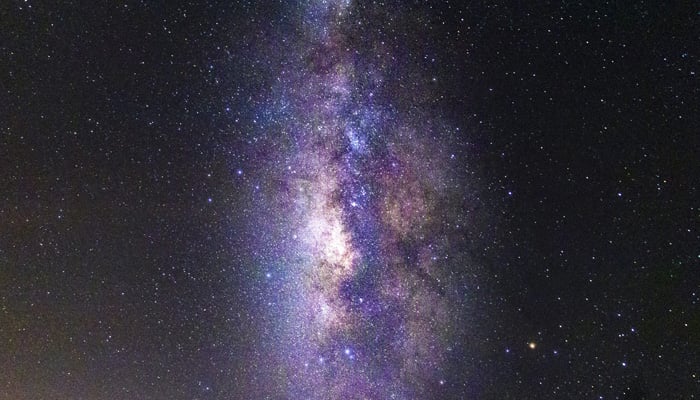
A fascinating new study suggests that our Milky Way galaxy might be accompanied by as many as 100 additional galaxies, which have remained undetected until now due to their extremely low luminosity. These potential galactic companions have been termed “orphan” galaxies.
This groundbreaking finding comes from cosmologists at Durham University in England. They employed a sophisticated methodology that integrates the world’s most advanced supercomputer simulations with intricate mathematical modeling, as reported by ABC News. The revelations were shared at the Royal Astronomical Society’s National Astronomy Meeting in Durham on Friday.
The simulations provided compelling indications of numerous unseen satellite galaxies closely orbiting our own. If these predictions are validated by future observations, this discovery could significantly alter our current understanding of the Milky Way’s cosmic architecture and the total number of galaxies in its immediate cosmic neighborhood.
Isabel Santos-Santos, the lead researcher from Durham University’s Institute for Computational Cosmology, explained: “We know the Milky Way currently has about 60 confirmed companion satellite galaxies, but our calculations suggest there could be dozens more of these faint galaxies orbiting at close distances.”
Researchers believe that if telescopes are able to detect these elusive galaxies, it would offer substantial corroboration for the Lambda Cold Dark Matter (ΛCDM) theory. This is the prevailing cosmological model that elucidates how galaxies form and describes the large-scale structure of the universe.
According to the ΛCDM model, galaxies emerge at the cores of immense concentrations of dark matter, known as halos. The model also postulates that the universe’s composition is approximately 5% ordinary matter, 25% cold dark matter, and a substantial 70% dark energy. Astronomers note that the majority of galaxies in the universe are low-mass dwarf galaxies that orbit larger ones, such as the Milky Way.
These satellite galaxies have historically presented a challenge to the ΛCDM model, as previous simulations often predicted a greater number of companions than what was observed. However, this novel technique has enabled the Durham researchers to more accurately trace the abundance, distribution, and characteristics of these faint “orphan” galaxies.
Carlos Frenk, a co-researcher at the Institute for Computational Cosmology, remarked that the model offers a “clear illustration” of the profound capabilities of physics and mathematics. The researchers highlighted that current simulations often lack the necessary resolution to effectively study these faint satellite galaxies and their associated dark matter halos, leading to data gaps. Should these new predictions prove accurate, it would undoubtedly fortify the ΛCDM model’s standing.
