

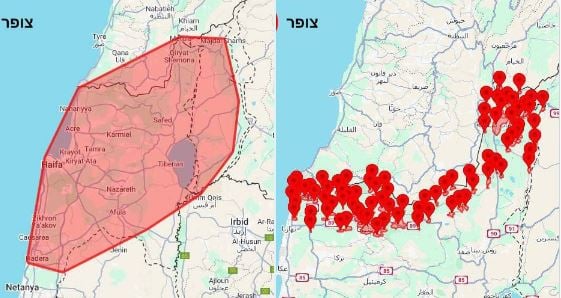
Tensions in the Middle East are escalating to dangerous new heights, with missile sirens continuously sounding across multiple Israeli cities, including Nahariya, Gesher Haziv, Hila, Me’ona, and Mi’ilya, following fresh projectile launches from Iran.
Iran’s Attacks and Strategic Targets
Iran’s state television Press TV reported that the Islamic Republic of Iran utilized Kheyber-Shakan, Emad, Qadr, and Fattah-1 missiles in today’s attacks. Iranian media are citing a statement from the Islamic Revolutionary Guard Corps (IRGC) detailing its latest assault on Israel. Tasnim news agency, quoting the IRGC, stated, “This wave was carried out with combined missile and drone operations using solid and liquid fuel missiles and utilizing special tactics to penetrate the layers of the Israeli air defence shield.” It added, “So far, rocket strikes have been recorded at five locations in the cities of Safad, Tel Aviv, Ashkelon, Ashdod, and Beisan.”
Israel’s Retaliation and Nuclear Site Strikes
Israel’s military announced that it began a series of strikes targeting military objectives in Tehran late on Monday morning. These strikes were initiated after Iran launched multiple waves of missiles at Israel, which directly impacted various areas, including a strategic electric infrastructure facility in southern Israel.
Read more:
- Israel attacks Fordow site, day after US strikes hit Iran’s nuclear facilities
In a statement, Israel’s military confirmed it attacked to “disrupt access routes” to the Fordow nuclear site, which was hit by the US yesterday. This follows Israel Army Radio quoting an unnamed security source who stated the army targeted an “access road” leading up to Fordow, rather than the facility itself. The Fordow facility is situated 30km (18.5 miles) northeast of the city of Qom in northwestern Iran and is reportedly hundreds of meters inside a mountain. It is the only Iranian facility where IAEA inspectors have found particles of uranium purified to near weapons-grade purity, discovered during an unannounced inspection in 2023.
Earlier on Monday morning, the IDF struck six airports in western, eastern, and central Iran, according to the military. Multiple missile impact sites have been reported across Israel, including Ashdod and an area south of West Jerusalem, as per Israeli media. The precise nature of the targeted sites remains unclear due to strict military censorship, which imposes severe penalties, including imprisonment, for sharing unauthorized information or footage from affected areas. Eyewitnesses in Israel and the occupied West Bank reported continuous air raid sirens lasting approximately 35 minutes, accompanied by loud explosions, indicating an intense and sustained assault. The missile barrage is believed to be part of Iran’s ongoing response to Israel’s attack on its nuclear facilities on June 13. Since then, Iran has reportedly launched around 450 ballistic missiles towards Israel, marking one of the most significant escalations in the region in recent years. The Israel Defense Forces (IDF) confirmed that sirens were also activated in central Israel after a missile launch from Iran, signaling a significant escalation in hostilities.
Iran Shoots Down Israeli Drone; Issues Warning to US
Iran’s Islamic Revolutionary Guard Corps (IRGC) successfully shot down an advanced Israeli Hermes drone early this morning over Khorramabad, in Lorestan Province. The Hermes drone is considered one of Israel’s most sophisticated surveillance and strike assets, making this a significant blow.
A spokesman for Iran’s Khatam al-Anbiya Central Headquarters issued a stern warning to “gambler” Trump, stating that “powerful and calculated operations with severe and unpredictable consequences await the United States” in response to its direct aggression and violation of Iran’s sovereignty. As the region stands on the brink of further escalation, the world is closely watching these fast-moving developments.
Iran stated on Monday that the U.S. attack on its nuclear sites expanded the range of legitimate targets for its armed forces and called U.S. President Donald Trump a “gambler” for joining Israel’s military campaign against the Islamic Republic. Since Trump joined Israel’s campaign by dropping massive bunker-buster bombs on Iranian nuclear sites on Sunday morning, Iran has repeatedly threatened to retaliate. However, while it has continued to fire missiles at Israel, it has yet to take action against the United States itself, either by firing at U.S. bases or by targeting the 20% of global oil shipments that pass near its coast at the mouth of the Gulf.
“Mr Trump, the gambler, you may start this war, but we will be the ones to end it,” Ebrahim Zolfaqari, spokesperson for Iran’s Khatam al-Anbiya central military headquarters, said on Monday in English at the end of a recorded video statement. Iran and Israel traded another wave of air and missile strikes on Monday as the world braced for Tehran’s response. Trump’s administration has repeatedly stated that its aim is solely to destroy Iran’s nuclear programme, not to ignite a wider war. However, in a social media post on Sunday, Trump openly spoke of toppling the hardline clerical rulers who have been Washington’s principal foes in the Middle East since Iran’s 1979 revolution. “It’s not politically correct to use the term, ‘Regime Change,’ but if the current Iranian Regime is unable to MAKE IRAN GREAT AGAIN, why wouldn’t there be a Regime change??? MIGA!!!” he wrote.
Experts analyzing commercial satellite imagery indicated that the U.S. attack appeared to have severely damaged, and possibly destroyed, the site of Iran’s Fordow nuclear plant, which is built inside a mountain, along with its uranium-enriching centrifuges. However, there has been no independent confirmation. Trump called the strike a “Bullseye!!!” and wrote, “Monumental Damage was done to all Nuclear sites in Iran. The biggest damage took place far below ground level.”
Further Israeli Strikes and Limited Iranian Retaliation
Israel’s airstrikes on Iran have encountered minimal resistance from Iranian defenses since Israel launched its surprise attack on June 13, which resulted in the deaths of many top Iranian commanders. The Israeli military reported on Monday that approximately 20 jets conducted a wave of strikes against military targets in western Iran and Tehran overnight. In Kermanshah, western Iran, missile and radar infrastructure were targeted, and in Tehran, a surface-to-air missile launcher was struck.
Iranian news agencies reported that air defenses had been activated in central Tehran districts, and Israeli airstrikes had hit Parchin, the location of a military complex southeast of the capital. Iran claims that over 400 people, mostly civilians, have been killed in the Israeli attacks, but has released few images of the damage since the initial days of the bombing. Tehran, a city of 10 million, has largely emptied, with residents fleeing to the countryside to escape attacks.
Iran’s retaliatory missile strikes on Israel have resulted in 24 civilian deaths and hundreds injured. This marks the first time a significant number of Iranian missiles have successfully penetrated Israeli defenses. The Israeli military stated that a missile launched from Iran in the early hours of Monday was intercepted by Israeli defenses. Air raid sirens blared overnight in Tel Aviv and other parts of central Israel.
Beyond these missile attacks, Iran’s capacity to retaliate is considerably more limited than a few months ago. This is because Israel inflicted a decisive defeat on Iran’s most feared regional proxy force, Hezbollah in Lebanon, whose downfall was swiftly followed by that of Iran’s most powerful client ruler, Syria’s Bashar al-Assad.
Oil Market Impact and Diplomatic Efforts
Iran’s most effective threat to harm the West would likely involve restricting global oil flows from the Gulf. Oil prices surged on Monday to their highest levels since January. However, they have not yet reached crisis levels, suggesting that traders foresee a resolution to the conflict that avoids severe disruption. Brent crude futures were down 0.5% to $76.64 a barrel as of 0830 GMT, after briefly jumping above $80 at the opening.
Iran’s parliament has approved a move to close the Strait of Hormuz, which leads into the Gulf. This action would require approval from the Supreme National Security Council, a body led by an appointee of Supreme Leader Ayatollah Ali Khamenei. Attempting to choke the strait could send global oil prices skyrocketing, derail the world economy, and invite conflict with the U.S. Navy’s massive Fifth Fleet, which patrols the Gulf from its base in Bahrain. “It’s economic suicide for them if they do it. And we retain options to deal with that,” U.S. Secretary of State Marco Rubio said.
As Tehran weighed its options, Foreign Minister Abbas Araqchi was expected to hold talks with Russian President Vladimir Putin in Moscow on Monday. The Kremlin maintains a strategic partnership with Iran but also has close ties with Israel. Speaking in Istanbul on Sunday, Araqchi stated that his country would consider all possible responses and that there would be no return to diplomacy until it had retaliated. TASS news agency later quoted him as saying Iran and Russia were coordinating their positions.
