

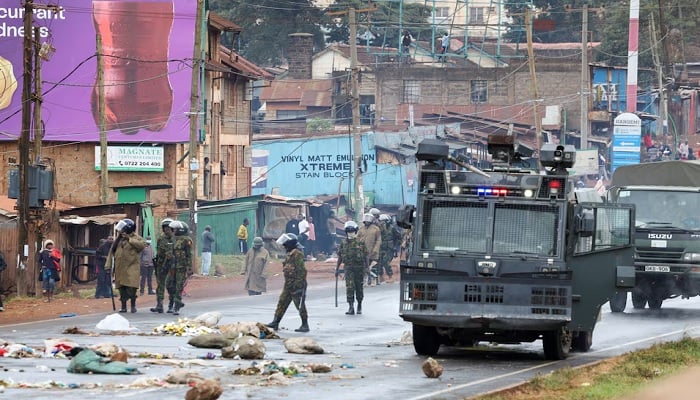
Kenyan police used force to disperse demonstrators in Nairobi on Monday, marking the 35th anniversary of pro-democracy rallies, with authorities reporting 11 fatalities nationwide in the latest anti-government protests to turn deadly.
Escalating Protests and Fatalities
The protests gained fresh momentum following the death of blogger Albert Ojwang in police custody last month, which has fueled public anger against the authorities. A Reuters reporter witnessed police opening fire on advancing protesters in Nairobi’s Kangemi suburb, where one man was later seen motionless with a bleeding wound. The Eagle Nursing Home in Kangemi reported admitting six injured people, two of whom died from gunshot wounds. Kenyatta National Hospital confirmed treating 24 injured individuals.
Kenya’s police stated that 11 people had died and 52 officers were injured, though they did not specify who was responsible for the civilian deaths. Their statement noted “fatalities, injuries, damage to motor vehicles, and several incidents of looting.”
Roots of Discontent and Police Conduct
Law enforcement agencies have maintained a heavy presence in Nairobi since youth-led protests in June 2024. These initial demonstrations, sparked by proposed tax hikes, have since broadened to encompass issues such as corruption, police brutality, and unexplained disappearances of government critics.
On Monday, police deployed tear gas and water cannons to disperse hundreds of demonstrators attempting to advance from Kangemi toward downtown Nairobi. Later, scuffles erupted, and a Reuters reporter observed police firing at charging crowds.
The government-funded Kenya National Commission on Human Rights (KNCHR) reported seeing “numerous hooded officers, not in uniform, travelling in unmarked vehicles.” This contravenes a court order requiring police to be easily identifiable, a measure put in place after allegations of plainclothes police firing live rounds at demonstrators last year. The KNCHR further stated that criminal gangs, armed with whips and machetes, appeared to be operating alongside police in Nairobi and Eldoret.
Demonstrations were also reported in Nyeri, Embu, and Nakuru, where police on horseback dispersed stone-throwing protesters. Police roadblocks significantly restricted access to and traffic within Nairobi, leaving streets deserted save for the protesters who arrived on foot. Many schools and a shopping mall were closed in anticipation of unrest.
Government Stance and Historical Context
Interior Minister Kipchumba Murkomen, who last month described the protests as “terrorism disguised as dissent,” affirmed on Sunday the government’s commitment to protecting life and property. He warned that security agencies were “on high alert to deal decisively with criminals and other elements of ill intent who may seek to infiltrate peaceful processions to cause havoc, mayhem, or destruction of property.”
Activists hold rallies every July 7, known as “Saba Saba” (Kiswahili for “Seven Seven”), to commemorate the day in 1990 when opponents of then-President Daniel Arap Moi began their push for a multi-party democracy in Kenya. Those protests ultimately led to the country’s first multi-party elections in over two decades, two years later.
The death of 31-year-old Albert Ojwang, a blogger and teacher, has galvanized public anger and ignited a series of demonstrations throughout June. The KNCHR reported that on June 25, 19 people died nationwide during protests against Ojwang’s death and to mark the first anniversary of rallies that culminated in the storming of parliament. Six individuals, including three police officers, have been charged with murder in connection with Ojwang’s death; all have pleaded not guilty.
