

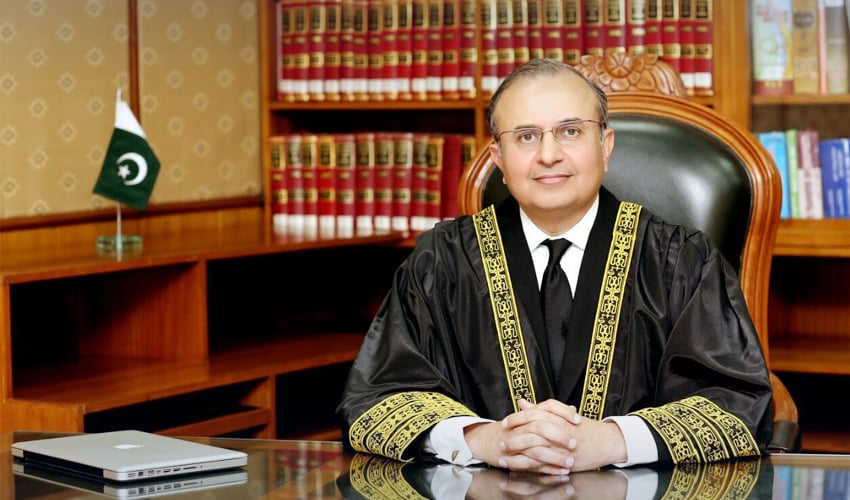
Senior Supreme Court Justice Mansoor Ali Shah has issued a cautionary statement, asserting that extending the tenure of the constitutional bench before a verdict on the 26th Amendment could severely erode public trust and exacerbate the ongoing crisis within the judiciary.
In a communication addressed to the Judicial Commission members, penned prior to the Commission’s June 19 meeting, Justice Shah voiced his objection to the proposed extension of judges’ terms on the constitutional bench.
Justice Shah highlighted that he had previously informed the Commission of his unavailability for the meeting due to being out of the country. He conveyed his disappointment that the meeting proceeded despite his absence, noting that previous sessions had been postponed because of executive members’ unavailability.
He suggested that the judiciary, currently in a minority position within the Commission, might have been unable to secure a postponement of the meeting.
In his correspondence, the most senior judge warned the Commission that proceeding with judicial tenure extensions before resolving the constitutional questions surrounding the 26th Amendment would convey a damaging message to the public and undermine institutional credibility.
“The expansion or reappointment of a bench whose constitutionality has been challenged deepens the institutional crisis and undermines the credibility of the court,” the letter stated.
“The continuous delay in deciding a fundamental constitutional issue like the 26th Amendment is damaging the credibility of the court and eroding public confidence.”
Justice Shah further advocated for the inclusion of all Supreme Court judges on the constitutional bench until the case is concluded, aiming to dispel any perceptions of bias or selective inclusion.
“Including a particular judge in the Constitution Bench without a transparent or established procedure affects impartiality and harmony within the institution,” he remarked.
Calling for systemic reform, Justice Shah emphasized the critical need for a formal, transparent mechanism to determine the composition of future constitutional benches. He cautioned that the existing process appears arbitrary and could lead to accusations of “cherry-picking” judges. “This unsystematic approach has already called into question the legitimacy of the constitutional bench, and the exclusion of senior judges without any reason only worsens this perception,” he observed.
The letter also addressed the second item on the meeting’s agenda—policy decisions concerning the formulation of rules under Article 175A(20) of the Constitution. Justice Shah recommended that any such decisions be deferred until the Supreme Court issues its ruling on the 26th Amendment case.
In his concluding remarks, Justice Shah underscored the imperative for integrity, transparency, and collective wisdom in the Commission’s deliberations. “The strength of the judiciary depends on its credibility, internal coherence, and commitment to constitutional principles—not on short-term interests or executive preferences,” he asserted.
The public release of Justice Shah’s letter contributes significantly to the ongoing discourse regarding judicial independence and the alleged influence of the executive in constitutional affairs. The 26th Amendment, which is currently under judicial review by the Supreme Court, pertains to crucial structural reforms within the judiciary and has become a focal point for broader institutional tensions.
