

ISLAMABAD, PAKISTAN
An alarming incident raising serious questions about press freedom in Pakistan occurred on Thursday when Islamabad police allegedly stormed the National Press Club (NPC) premises, using batons to attack and injure several journalists. The incident has drawn immediate condemnation and prompted an ordered inquiry by Interior Minister Mohsin Naqvi.
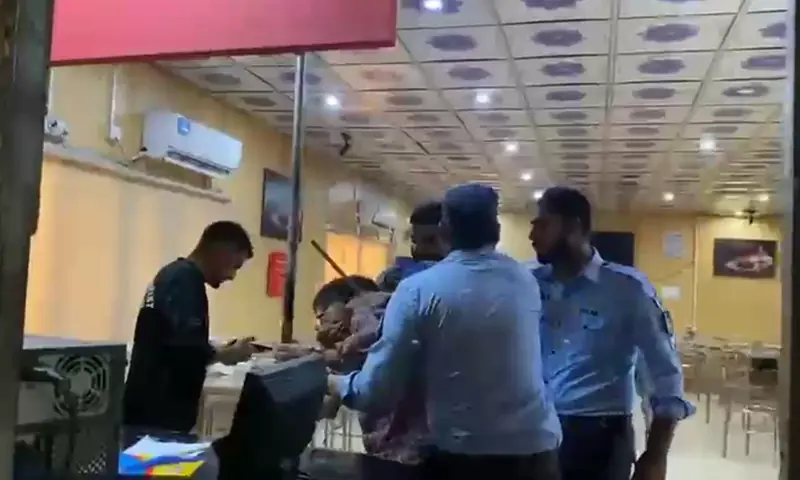
Visual evidence, widely circulated on television and social media, showed uniformed police personnel, armed with batons, clashing with reporters and camera operators inside the press club compound. In one widely shared visual, officers were seen dragging journalists out of what appeared to be the cafeteria. Another video captured a journalist whose shirt was ripped across the back, holding his broken Nikon camera—a clear demonstration of the force employed.
Journalist Community Demands Accountability
The leadership of the country’s media bodies responded swiftly. Pakistan Federal Union of Journalists (PFUJ) President Afzal Butt, speaking at a press conference alongside Minister of State for Interior Talal Chaudhry, detailed the severity of the assault. Butt stated that when press club office-bearers attempted to intervene, they were “beaten and tortured,” and two individuals were briefly arrested.
Butt emphasized the gravity of the violation, calling the incident a matter of “now or never” for the journalistic fraternity. “Something like this has never happened before,” he asserted, highlighting that officers illegally entered a photographer’s “second home… beat him and break his camera and mobile phone.” He announced an emergency session of the PFUJ to formulate concrete demands for the government, fearing that if this “worst of the worst incident” is overlooked, similar raids could occur in Lahore, Karachi, and other major cities.
Official Response and Contradictory Accounts
Interior Minister Mohsin Naqvi immediately took notice of the “unfortunate” incident, demanding a report from the Islamabad Inspector General of Police. In a strong statement, Naqvi said, “Violence against the journalist community cannot be tolerated under any circumstances,” and directed that disciplinary action be taken against all involved officials.
Minister of State for Interior Talal Chaudhry offered an unconditional apology, stating he was ready to meet with the PFUJ after their emergency session. However, his office’s statement offered a partial explanation, claiming the incident happened “suddenly” when police were pursuing protesters from the Azad Jammu and Kashmir Joint Awami Action Committee (JAAC). The statement alleged that some protesters had “manhandled police personnel,” and police chased them into the press club to execute arrests.
Information Minister Attaullah Tarar called the incident “regrettable,” stressing that the police operation was not ordered by Minister Naqvi and vowing a comprehensive investigation.
Widespread Condemnation for Breach of Sanctuary
The raid drew immediate and widespread condemnation from human rights advocates. The Human Rights Commission of Pakistan (HRCP) strongly denounced the “assault on journalists by Islamabad police” at the National Press Club, demanding an immediate inquiry and accountability for those responsible.
Veteran journalist Syed Talat Hussain described the action as “madness without any method,” questioning the logic of treating the National Press Club—a symbolic sanctuary for media—”as a criminal hideout” and using violence on its premises. Journalist Anas Mallick alleged the raid was specifically aimed at Kashmiri journalists covering a JAAC protest, condemning the police for “acting like thugs.”
The collective outrage underscores a deep-seated fear that the government is failing to uphold the fundamental right to report, signaling a difficult period for media freedom in the country.
