

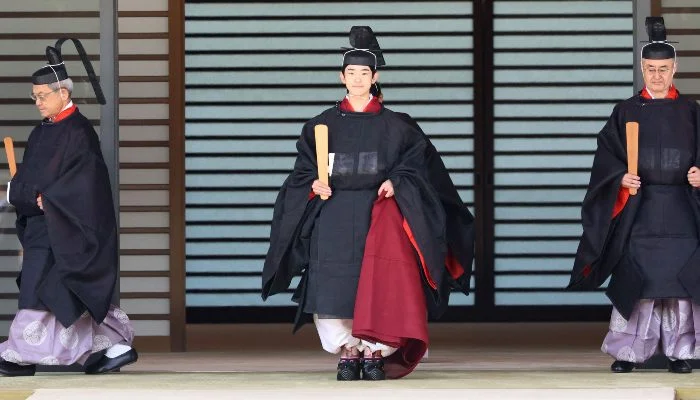
Prince Hisahito’s coming-of-age was celebrated with an elaborate ceremony at the Imperial Palace on Saturday, even as a succession crisis continues to loom over Japan’s monarchy. The nephew of Emperor Naruhito, Hisahito was presented with a black silk and lacquer crown at the event, which signifies the start of his adult royal life.
“Thank you very much for bestowing the crown today at the coming-of-age ceremony,” Hisahito said. “I will fulfill my duties, being aware of my responsibilities as an adult member of the imperial family.”
Although the emperor has a daughter, 23-year-old Princess Aiko, she has been sidelined by the royal family’s male-only succession rules. “As a young member of the Imperial Family, I am determined to fulfill my role,” Hisahito stated in March. Second in line to the throne after his father, the 19-year-old will also visit the Tokyo palace to pay respects to gods and ancestors.
While tradition dictates that only a man can carry on the imperial line—which, according to legend, dates back 2,600 years—public opinion polls have shown strong support for a woman taking the throne. “It makes no difference to me whether a woman becomes the emperor or a man does,” said Tokyo bartender Yuta Hinago, 33, who feels there could be “room for more flexibility” in the succession rules.
Japan has been debating royal succession for decades. A key government panel in 2005 recommended that it pass to the oldest child regardless of their sex, which appeared to pave the way for the emperor’s daughter to ascend to the Chrysanthemum Throne. However, Hisahito’s birth the following year effectively silenced the debate. According to Kenneth Ruoff, director of the Centre for Japanese Studies at Portland State University, politicians have been slow to act, “kicking the can down the road” and delaying a solution with a youthful Hisahito in view.
Traditionalists have argued that the “unbroken imperial line” of male succession is the foundation of Japan, and that major changes would divide the nation. Under the post-war constitution, the royal family holds no political power.
Pressure on Women and Potential Reforms
As royal daughters are forced to leave the family after marriage, one modernizing proposal would allow them to continue their public duties after their nuptials. Conservatives, meanwhile, are pushing for the royal household to bring back distant male relatives to continue the lineage. However, it remains unclear if those men would be willing to give up their careers and freedom for such a role.
Hisahito said this year that he has “not yet thought deeply” about his own marriage prospects, which could prove challenging. Historically, women who marry into the royal family have faced intense pressure to produce sons and have been constant subjects of gossip. Empress Masako, a former high-flying diplomat, struggled for years with a stress-related illness after joining the household, which some attribute to the pressure to have a male heir. Empress Emerita Michiko, Naruhito’s mother, also suffered from stress-induced illnesses.
Hisahito’s sister, Mako, married her university boyfriend, Kei Komuro. She has faced intense tabloid reporting over claims that Kei’s family had financial difficulties, leading the former princess to develop complex post-traumatic stress disorder. The couple has since moved to the United States, where they recently had a baby. Other members of the royal family are also regular subjects of online and media gossip.
Despite broad public support for changing the succession rules, royal historian Hideya Kawanishi told AFP that away from the pomp and pageantry, most people are focused on other issues, such as rising inflation. “If people who are generally supportive [of women emperors] become a bit louder, then politicians can become more serious,” said Kawanishi, an associate professor at Nagoya University. “But when ceremonies end, society, including the media, calms down and moves on.”
