

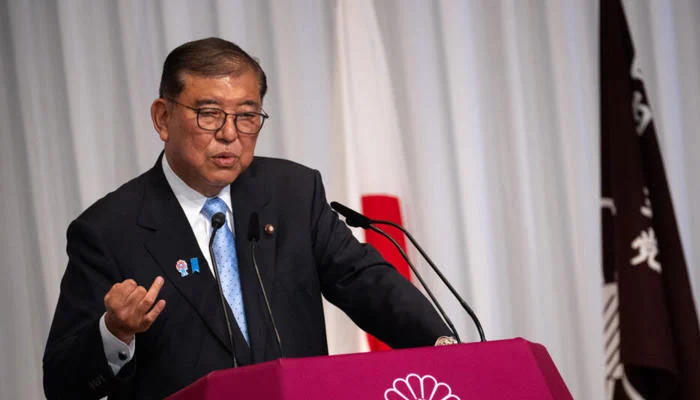
Japanese Prime Minister Shigeru Ishiba announced on Monday his intention to remain in office, despite his coalition government enduring what he termed an “extremely regrettable” election outcome, with the prospect of new, impactful US tariffs looming.
In Sunday’s election, Ishiba’s Liberal Democratic Party (LDP), a political force that has governed almost continuously since 1955, alongside its coalition partner Komeito, fell an estimated three seats short of securing a majority in the upper house. Local media reports indicate that 125 seats were contested within the 248-seat upper house. The coalition had aimed for 50 of these contested seats but ultimately secured only 47 (LDP won 39, Komeito won 8), leaving them with a total of 122 deputies. This represents a decline of 19 seats from their previous holdings of 141 and marks a historic first since the LDP’s establishment in 1955, as the party now finds itself in a minority government in both chambers of parliament.
Voters, expressing their discontent over inflation, shifted their allegiance to other political entities. Notably, the “Japanese first” Sanseito party experienced substantial gains, resonating with its “anti-globalist” stance, a sentiment mirroring populist movements observed globally. Kazuyo Nanasawa, a 25-year-old voter who cast her ballot for a smaller ultra-conservative party, conveyed to AFP, “I even think (the LDP) should have lost more.” She further suggested that Ishiba ought to resign.
This electoral setback comes merely months after Ishiba’s coalition was relegated to a minority government status in the more influential lower house, marking the LDP’s most significant electoral defeat in 15 years. However, when queried late Sunday about his commitment to remaining in power, Ishiba unequivocally responded to local media, “That’s right.”
During a press conference on Monday, Ishiba articulated, “Changes in the external environment, such as the international situation, or natural disasters, cannot wait for the political situation to improve.” He continued, “For this reason, although I’m acutely aware of our grave responsibility for the election results, in order to not let politics become stagnant, I believe I must fulfil my responsibility as the party with the most votes and to the people of the country, while listening carefully and sincerely to the voices of the local people.”
The immediate future regarding Ishiba’s potential successor remains unclear, especially given that the government now requires opposition backing in both parliamentary chambers to enact legislation. Takeshi Nemoto, an 80-year-old LDP supporter, informed AFP that a fresh leadership contest would prove “a losing battle” for the party, potentially complicating ongoing tariff negotiations with US President Donald Trump’s administration. Shuhei Aono, 67, concurred, observing, “Diplomacy is under pressure at the moment. Who is going to take care of it? I think (Ishiba) cannot easily withdraw.”
Opposition’s Ascendance and Ideological Platforms: The election witnessed the Constitutional Democratic Party of Japan (CDP) securing the second position with 22 contested seats. Following them was the Democratic Party For the People (DPP), which won 17 seats, increasing its total to 22. The right-wing Sanseito party achieved notable successes, securing 14 seats. Sanseito’s platform advocates for “stricter rules and limits” on immigration, opposes “radical” gender policies, and calls for a re-evaluation of decarbonization strategies and vaccine policies. Last week, the party was compelled to disavow any connections to Moscow—which has supported populist parties in other regions—after one of its candidates was interviewed by Russian state media.
Hidehiro Yamamoto, a professor of politics and sociology at the University of Tsukuba, commented to AFP that the opposition remains fragmented, rendering the chances of these parties forming an alternative government rather slim. He suggested that expanding the existing coalition would be challenging, with the DPP being the most probable partner “on the condition that (the government) delivers some of the positive fiscal measures, such as tax cuts.” It appears more probable that Ishiba will continue to rely on case-by-case opposition support to pass legislative measures.
Economic Pressures and Tariff Implications: Following years of stagnant or declining prices, consumers in the world’s fourth-largest economy have been experiencing financial strain due to inflation since Russia’s 2022 invasion of Ukraine. Specifically, the price of rice has doubled, significantly impacting numerous household budgets despite government handouts. The lingering resentment stemming from an LDP funding scandal has also contributed to public dissatisfaction. Further compounding these challenges are the impending US tariffs of 25%, set to take effect from August 1 if no trade agreement is finalized. Japanese imports are already subject to a 10% tariff, while the automotive industry, which accounts for 8% of Japan’s jobs, is particularly vulnerable to a 25% levy. On Monday, tariffs envoy Ryosei Akazawa departed for his eighth visit to Washington. Ishiba affirmed, “We will achieve an agreement that is beneficial to both Japan and the US, based on the concept of investment rather than tariffs.”
