

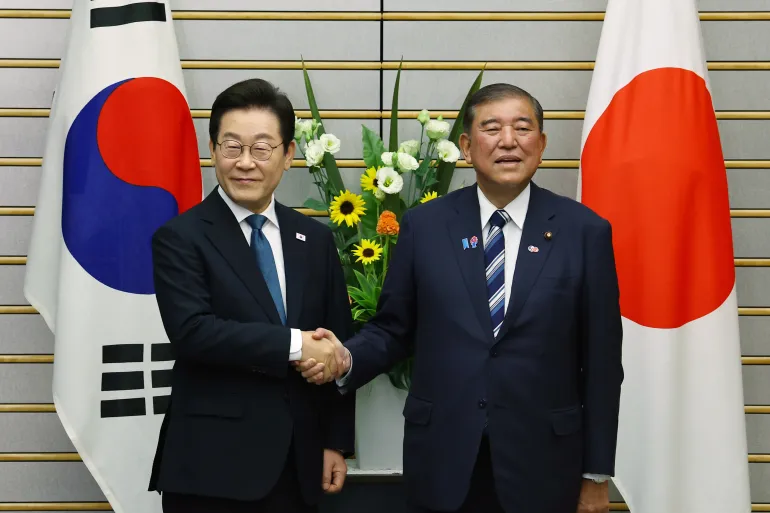
Japan’s leader, Ishiba, stated in a joint announcement with South Korean President Lee after their meeting that “as the strategic environment surrounding both our countries grows increasingly severe, the importance of our relations, as well as trilateral cooperation with the United States, continues to grow.” The two leaders agreed to resume ‘shuttle diplomacy,’ expand exchanges such as ‘working holiday programmes,’ and strengthen cooperation in defence, economic security, artificial intelligence, and other areas. They also pledged closer coordination against North Korea’s nuclear and missile threats.
Following the impeachment of President Yoon Suk Yeol for declaring martial law, the snap election victory of the liberal Lee had raised concerns in Tokyo that relations with Seoul could sour. Lee has previously criticized past efforts to improve ties strained by lingering resentment over Japan’s colonial rule. Last week, the South Korean government expressed “deep disappointment and regret” after Japanese officials visited a shrine to Japan’s war dead, which many Koreans view as a symbol of Japan’s wartime aggression.
However, in Tokyo, Lee reaffirmed his support for closer relations with Japan, just as he did when he first met Ishiba in June on the sidelines of a G7 summit in Canada. Lee’s decision to visit Tokyo before Washington has been well received by Japanese officials, who see it as a sign that Lee is placing great importance on the relationship between the two neighbours. For Ishiba, who faces pressure from right-wing rivals within his governing party to resign over its July election loss, Lee’s visit and a successful summit could shore up his support.
Despite their differences, both US allies heavily rely on Washington to counter China’s growing regional influence. Together, they host approximately 80,000 US soldiers, dozens of US warships, and hundreds of military aircraft. Japan and South Korea also share common ground on trade, with both agreeing to 15 percent tariffs on US imports of their goods after Trump had threatened steeper duties.
Standing alongside Ishiba, Lee stated that “we agreed that unwavering cooperation between South Korea, the US, and Japan is paramount in the rapidly changing international situation, and decided to create a virtuous cycle in which the development of South Korea-Japan relations leads to stronger cooperation.” Lee’s visit comes two days before his crucial first summit in Washington with US President Donald Trump. The two men are expected to discuss security concerns, including China, North Korea, and Seoul’s financial contribution for US forces stationed in South Korea, something the US leader has repeatedly pressed it to increase.
