

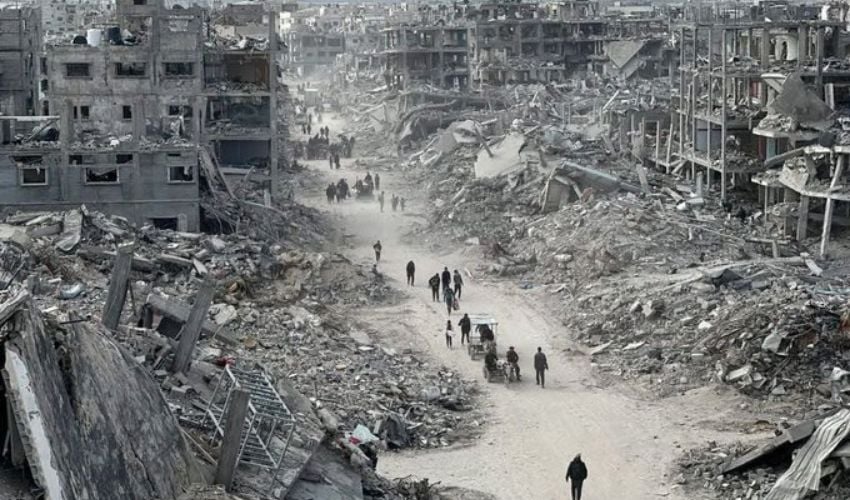
On Tuesday, Israel announced the start of its long-awaited ground operation into Gaza City, with Defence Minister Israel Katz declaring “Gaza is burning.” An Israeli military official stated that the Israeli Defence Forces (IDF) had begun the main phase of their ground assault on the enclave’s primary urban center, where Israel had previously ordered hundreds of thousands of residents to evacuate.
The military provided few initial details but confirmed that its troops had started “dismantling Hamas terrorist infrastructure in Gaza City.” In a post on X, Katz wrote, “The IDF strikes with an iron fist at the terrorist infrastructure and IDF soldiers are fighting bravely to create the conditions for the release of the hostages and the defeat of Hamas.”
Residents reported a dramatic increase in the intensity of the bombardment over the past two days. They described heavier explosions that destroyed dozens of homes, with naval boats joining tanks and planes in shelling the coast. Israeli Prime Minister Netanyahu, during an ongoing corruption trial, stated, “We have launched a significant operation in Gaza.”
US Support for Israeli Stance
During his visit on Monday, U.S. Secretary of State Marco Rubio offered apparent backing for the Israeli government’s decision to forgo ceasefire talks in favor of a full-scale offensive against Hamas. Rubio stated that while the U.S. desired a diplomatic resolution, “we have to be prepared for the possibility that’s not going to happen.” He endorsed Israel’s demand that Hamas surrender its weapons and immediately release all remaining hostages as the only way to end the war.
Gaza health officials reported that at least 24 people were killed in the early hours of the assault, with most of the casualties occurring in Gaza City.
Political and Humanitarian Crisis
Netanyahu had ordered the military last month to capture Gaza City, which he has called the last stronghold of Hamas. Although much of the city was already devastated in the early weeks of the 2023 war, about 1 million Palestinians had returned to their homes amidst the ruins. Forcing them out means nearly the entire population of Gaza will now be displaced to temporary encampments along the southern coast, in what Israel refers to as a “humanitarian area.”
The United Nations and other nations critical of Israel’s tactics argue that these actions amount to forced mass displacement. They warn that conditions in the crowded southern areas are dire, with a severe lack of food and other resources.
Some Israeli military commanders have also expressed concerns about the operation, warning that it could endanger the remaining hostages and potentially be a “death trap” for troops. At a meeting on Sunday, Israeli Army Chief of Staff Eyal Zamir reportedly urged Netanyahu to pursue a ceasefire deal. This has led to protests from hostage families outside Netanyahu’s home, with one family member stating that the Prime Minister’s actions could put their loved ones at risk and jeopardize any potential deal for their release.
