

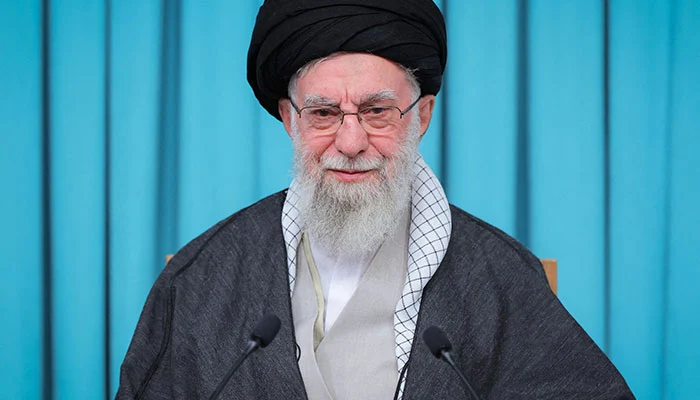
Iran’s Supreme Leader Ayatollah Ali Khamenei has rejected talks with Washington, stating that negotiations with the US serve no national interest for his country. He believes the outcome is predetermined by the US—the termination of Iran’s nuclear enrichment program. According to Khamenei, “This isn’t a negotiation—it’s dictation.”
Defending uranium enrichment, the Iranian leader said it affects various aspects of people’s lives, including agriculture, the environment, electricity, medicine, and other industries.
In a social media post on Tuesday, he also revealed that Iran has achieved an advanced level in uranium enrichment. He clarified that Iran does not need nuclear weapons, emphasizing that it has enriched uranium to 60%, while countries aiming for nuclear weapons enrich uranium up to 90%.
He further explained that out of 10 countries with uranium enrichment capabilities, only Iran does not have a nuclear bomb and has no intention of developing one.
European powers, who are seeking to soon reimpose tough sanctions on Iran over its nuclear program, met with Tehran’s top diplomat on Tuesday, but there were no signs of a compromise. However, there was an agreement to continue talks as the deadline for the reinstatement of sanctions on Iran’s economy loomed, even as Iran’s supreme leader resisted European pressure.
“Iran must never obtain a nuclear weapon,” German Foreign Minister Johann Wadephul told reporters before the meeting on the sidelines of the UN General Assembly in New York. However, he added: “The chances of reaching a diplomatic solution before the sanctions go into effect are slim.”
Khamenei said the Islamic republic would not give in to pressure to abandon its uranium enrichment. “We did not surrender and we will not. We did not and will not yield to pressure in this matter or any other matter,” he said.
Iran’s foreign ministry stated that “it was agreed that consultations with all parties involved would continue.” Iranian Foreign Minister Abbas Araghchi has until the end of Saturday to reach a deal with his British, French, German, and EU counterparts to avoid the reinstatement of UN sanctions, which had been suspended under a 2015 agreement.
‘The Most Dangerous Weapon’
Araghchi met in New York with his counterparts from the three European powers as well as EU foreign policy chief Kaja Kallas. Both Iran and the European nations blamed each other for the failure of diplomatic efforts to reach a new agreement on Tehran’s nuclear program, which has long been a point of contention. European countries and the United States suspect the Iranian government of seeking to acquire an atomic bomb. Tehran has vehemently denied this, insisting it has the right to civilian nuclear energy.
In June, Israel carried out a major military campaign against Iranian nuclear sites, with President Donald Trump joining by ordering US warplanes to drop bombs on key targets. The Trump administration, which had long pushed for the reimposition of sanctions, has expressed a willingness to hold talks with Iran, which doubts Washington’s sincerity.
IAEA Director-General Rafael Grossi told AFP on Monday that US envoy Steve Witkoff was exploring different ways of communicating with Iran, without providing further details. The United States has not commented on any contact with Iran in New York.
However, Khamenei said that “one cannot negotiate with such a party. In my view, negotiations with the United States on the nuclear issue, and perhaps on other issues as well, are a complete dead end.”
Addressing the UN General Assembly, Trump claimed that US warplanes succeeded in “totally obliterating” Iranian nuclear sites. “My position, it’s very simple. The world’s number-one sponsor of terror can never be allowed to possess the most dangerous weapon,” Trump said.
The European side has set three conditions to extend the sanction relief period to allow more time for negotiations on a comprehensive treaty. These include the resumption of direct negotiations without preconditions, full access for International Atomic Energy Agency (IAEA) inspectors to Iranian nuclear sites, and accurate information on the location of enriched materials. The European side believes that none of these conditions have been met.
Tehran accuses the European powers of exerting political pressure that undermines negotiations and claims to have produced a “balanced” proposal, the details of which have not been disclosed.
