

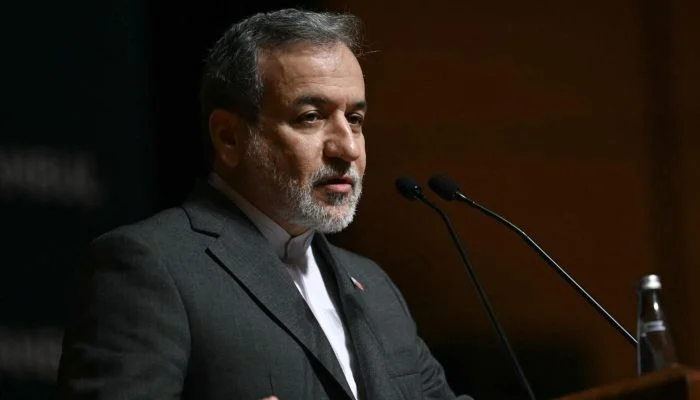
Iran’s foreign minister, speaking ahead of renewed talks with European powers, stated that the country has no intention of abandoning its nuclear program, including uranium enrichment, despite the “severe” damage inflicted on its facilities by recent US strikes.
Iran is scheduled to convene with Britain, France, and Germany in Istanbul on Friday to discuss its nuclear program. Tehran has accused European powers of undermining the landmark 2015 nuclear deal.
This upcoming meeting marks the first since Iran’s 12-day conflict with Israel last month, during which the United States carried out strikes against Tehran’s nuclear sites. “For now, enrichment is stopped because, yes, damages are serious and severe,” Iranian Foreign Minister Abbas Araghchi told Fox News’ “Special Report with Bret Baier” on Monday. He continued, “But obviously we cannot give up enrichment because it is an achievement of our own scientists,” describing it as a source of “national pride.”
US President Donald Trump responded to these remarks on his Truth Social platform, asserting that Washington would conduct further strikes “if necessary.” The 2015 agreement, formalized between Iran and the UN Security Council’s permanent members (Britain, China, France, Russia, and the United States), plus Germany, imposed restrictions on Iran’s nuclear program in exchange for the lifting of sanctions.
However, the agreement began to unravel in 2018 when the United States, under Trump’s first term, unilaterally withdrew and reimposed sweeping sanctions. Although Europe pledged ongoing support, a mechanism designed to counteract US sanctions never effectively materialized, compelling numerous Western companies to exit Iran and exacerbating its economic crisis.
“Iran holds the European parties responsible for negligence in implementing the agreement,” stated foreign ministry spokesman Esmaeil Baqaei ahead of Friday’s talks in Istanbul concerning the deal’s future. Iran will also host a trilateral meeting on Tuesday with Chinese and Russian representatives to discuss the nuclear issue and potential sanctions.
The Chinese foreign ministry affirmed that Beijing would “continue to play a constructive role in pushing relevant sides to restart dialogue and negotiations, and reach a solution that takes into account the legitimate concerns of all parties.” In recent weeks, the three European powers have threatened to reimpose international sanctions on Tehran, accusing it of violating its nuclear commitments.
Germany indicated that the Istanbul talks would be at an expert level, with the European trio, or E3, working “flat out” to achieve a sustainable and verifiable diplomatic resolution. Its foreign ministry spokesman, Martin Giese, warned, “If no solution is reached by the end of August… the snapback also remains an option for the E3.”
A clause within the 2015 agreement allows for UN sanctions on Iran to be reinstated through a “snapback” mechanism in the event of non-compliance. However, the agreement is set to expire in October, imposing a tight deadline.
‘No Intention of Engaging with America’
The International Atomic Energy Agency reports that Iran is currently the only non-nuclear-armed country enriching uranium to 60% – significantly surpassing the 3.67% cap established by the 2015 accord. This level is a mere step away from the 90% enrichment required for a nuclear weapon.
Baqaei dismissed the use of the snapback clause as “meaningless, unjustifiable, and immoral” during a news conference, contending that Iran only began reducing its commitments in response to Western non-compliance. He emphasized, “Iran’s reduction of its commitments was carried out in accordance with the provisions outlined in the agreement.”
Western powers – led by the United States and supported by Israel – have long accused Tehran of secretly pursuing nuclear weapons. Iran has consistently denied these allegations, maintaining that its nuclear program is exclusively for civilian purposes, such as energy production.
Tehran and Washington had conducted five rounds of nuclear talks commencing in April, but a planned meeting on June 15 was canceled after Israel initiated strikes on Iran, triggering a 12-day conflict. “At this stage, we have no intention of speaking with America,” Baqaei declared on Monday.
Israel launched a series of surprise strikes on its regional adversary on June 13, targeting key military and nuclear facilities. The United States conducted its own strikes against Iran’s nuclear program on June 22, hitting the uranium enrichment facility at Fordo, in Qom province south of Tehran, as well as nuclear sites in Isfahan and Natanz.
