

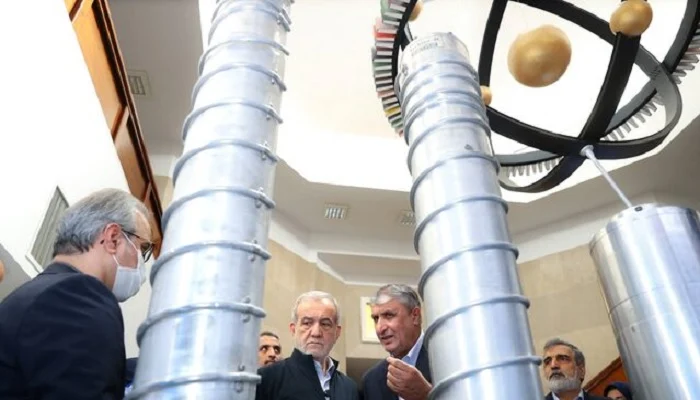
On Monday, Iran declared that new nuclear negotiations with the United States would not proceed if they were contingent on Tehran abandoning its uranium enrichment activities.
Washington and Tehran had engaged in multiple rounds of talks aimed at reaching an agreement on the Islamic Republic’s nuclear program. However, these discussions were disrupted when Israel launched a series of surprise strikes against its regional adversary, igniting a 12-day conflict.
Following the cessation of hostilities, both Iran and the United States have signaled a willingness to resume discussions. Nevertheless, Tehran has firmly stated it will not relinquish its right to the peaceful use of nuclear power.
“If the negotiations must be conditioned on stopping enrichment, such negotiations will not take place,” Ali Velayati, an adviser to Supreme Leader Ayatollah Ali Khamenei, was quoted as saying by the state news agency IRNA.
These remarks followed foreign ministry spokesman Esmaeil Baqaei’s statement that Iran had not yet set a date for any meeting with the United States.
“For now, no specific date, time or location has been determined regarding this matter,” Baqaei stated concerning plans for a meeting between Iran’s top diplomat, Abbas Araghchi, and US envoy Steve Witkoff.
Araghchi and Witkoff had previously failed to finalize an agreement after five rounds of talks that commenced in April. These represented the highest-level contact between the two nations since Washington withdrew from a landmark nuclear agreement in 2018.
The Omani-mediated negotiations were suspended when Israel initiated its surprise assault on Iranian nuclear and military facilities on June 13. The United States subsequently joined its ally, conducting limited strikes.
“We have been serious in diplomacy and the negotiation process, we entered with good faith, but as everyone witnessed, before the sixth round, the Zionist regime, in coordination with the United States, committed military aggression against Iran,” Baqaei asserted.
Iranian President Masoud Pezeshkian affirmed in a Monday statement that Iran “supports diplomacy and constructive engagement.”
“We continue to believe that the window for diplomacy remains open, and we will seriously pursue this peaceful path.”
Israel and Western nations accuse Iran of seeking nuclear weapons, an allegation Tehran has consistently denied.
While Iran is the sole non-nuclear weapons power to enrich uranium to 60-percent purity — a level close to that required for a warhead — the UN’s atomic energy watchdog has stated it has no indication Iran is working to weaponize its stockpiles.
Sanctions and Regional Fallout
Israel’s offensive, which it claimed aimed to thwart a nuclear threat from the Islamic Republic, resulted in the deaths of nuclear scientists and high-ranking military officers, and also impacted residential areas.
The United States initiated its own series of strikes on June 22, targeting Iran’s uranium enrichment facility at Fordo in Qom province, south of Tehran, as well as nuclear sites in Isfahan and Natanz.
Iran retaliated with missile and drone attacks against Israeli cities and struck a US base in Qatar in response to Washington’s actions.
The full extent of the damage to the Islamic Republic’s nuclear program remains undisclosed, with Baqaei stating it is “still under investigation.”
Pezeshkian, in his recent statement, cautioned of an “even more crushing retaliation” to any “new aggression against Iranian territory.”
Baqaei confirmed on Monday that Iran maintains contact with Britain, France, and Germany, the three European parties to the 2015 nuclear deal from which the United States later withdrew.
The European nations have threatened to activate the deal’s “snapback” mechanism, which allows the re-imposition of UN sanctions in cases of non-compliance.
Baqaei stated that Tehran is “in continuous contact with these three countries” but added he “cannot provide an exact date” for the next meeting with them.
According to Baqaei, there was “no legal, moral or political basis” for re-imposing sanctions, as Iran remains committed to the 2015 agreement.
He further added that such a move would be met with an “appropriate and proportionate” response, following previous Iranian threats to withdraw from the global nuclear non-proliferation treaty.
After the United States pulled out of the 2015 deal with Iran during Donald Trump’s first term as president, Tehran began rolling back its commitments to the agreement, which had restricted its atomic activities in exchange for sanctions relief.
“The Islamic Republic of Iran still considers itself a member of the JCPOA,” Baqaei affirmed, referring to the 2015 agreement.
