

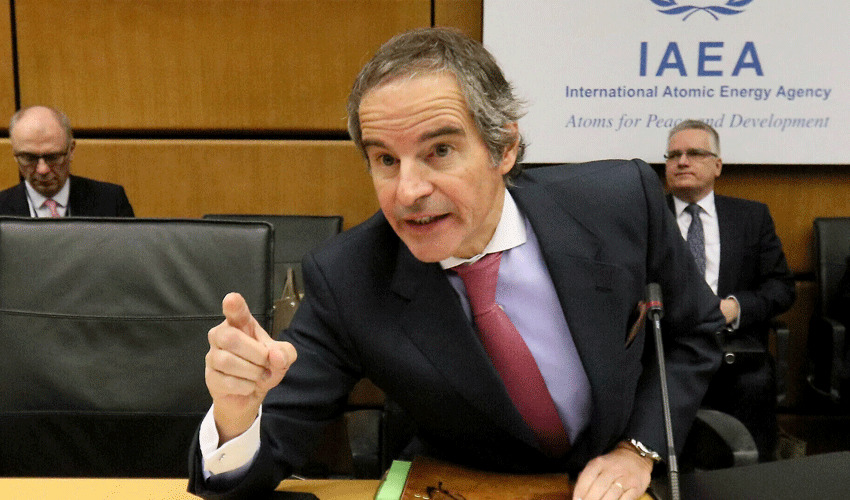
Iran has submitted a formal complaint to the United Nations Secretary-General and the President of the Security Council against Rafael Grossi, the head of the International Atomic Energy Agency (IAEA). The complaint accuses Grossi of bias and negligence amid escalating tensions surrounding Iran’s nuclear program.
The move, reported by Iran’s semi-official Fars News Agency, comes as Tehran intensifies its criticism of the nuclear watchdog’s handling of what it describes as “peaceful nuclear activities.” This also follows Grossi’s alleged silence regarding recent Israeli strikes on Iranian nuclear sites.
Amir-Saeid Iravani, Iran’s Permanent Representative to the United Nations, condemned what he termed Grossi’s “politicized” stance. In a letter to the UN, Iravani criticized the IAEA chief for “failing to take a clear position on Israel’s aggressive actions,” particularly its reported attacks on Iranian nuclear facilities, which Tehran asserts constitute a violation of international law.
Mohammad Eslami, the head of Iran’s Atomic Energy Organization, also announced on Thursday that legal action may be pursued against Grossi for his “inaction” in the face of what Iran perceives as threats to its nuclear infrastructure by Israel.
Tensions have escalated following Grossi’s remarks earlier this month, where he stated that Iran had failed to provide sufficient information about its nuclear activities. “The agency will not be in a position to provide assurance that Iran’s nuclear programme is exclusively peaceful,” he warned.
Addressing the UN Security Council on Friday, Grossi further expressed concern over security risks, stating that recent attacks on Iranian nuclear facilities had resulted in a “sharp degradation in nuclear safety and security.”
This standoff occurs at a time of heightened regional instability and uncertainty concerning the future of nuclear diplomacy. Talks to revive the 2015 Iran nuclear deal, known as the Joint Comprehensive Plan of Action (JCPOA), have long stalled, while Iran continues to expand its uranium enrichment program.
Iran maintains that its nuclear program is solely for civilian purposes, but Western powers and the IAEA have repeatedly expressed doubts, citing a lack of transparency and restrictions on inspections.
