

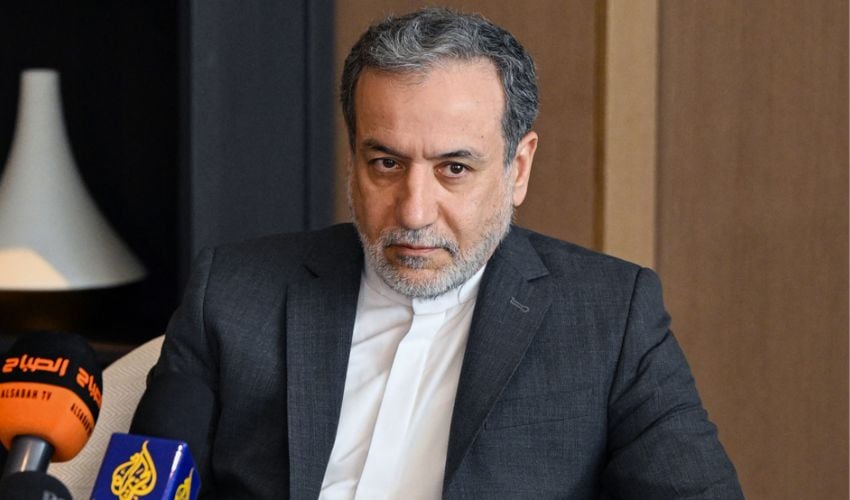
In a passionate address to the United Nations Human Rights Council, Iranian Foreign Minister Abbas Araqchi accused Israel of launching “unprovoked and unjustified aggression” against Iran, labeling it a “blatant violation of international law” and a “direct attack on diplomacy.”
Araqchi informed the council that Israel’s “surprise military assault,” which commenced in the early hours of Friday, June 13, 2025, has resulted in dozens of Iranian casualties, including off-duty military personnel, university professors, and civilians. He asserted, “This is an unjust war imposed on my people… when Israel perpetrated a mix of unlawful and criminal operations.” The foreign minister claimed that residential areas, public infrastructure, hospitals, health centers, the foreign ministry, and nuclear facilities were deliberately targeted—a move he described as a “grave war crime” with the potential for “environmental and radiological disaster.”
‘Attack During Active Diplomacy’
Crucially, Araqchi revealed that the Israeli attacks transpired “in the middle of an ongoing diplomatic process.” He stated that on June 15, 2025, Iran was slated to hold talks with the United States to “finalize a promising agreement regarding our peaceful nuclear program,” thus characterizing the Israeli actions as a “betrayal of diplomacy.”
Araqchi unequivocally condemned the Israeli actions as an “unprecedented blow to the foundation of international law and the UN system,” specifically referencing Article 2, Paragraph 4 of the UN Charter, which prohibits the use of force against the sovereignty of any state. He warned that inaction by the international community would lead to the severe “corrosion” of the entire UN-based international law system.
No US Talks Until Israeli Aggression Halts
While emphasizing Iran’s continued commitment to dialogue with European powers, including ongoing talks with Britain, France, and Germany in Geneva, Araqchi made it clear that no negotiations with the United States would occur unless Israel immediately ceases its military aggression. “The United States is a party to this aggression,” he told reporters in Geneva. “We cannot negotiate peace with a partner that is complicit in war.”
Missile Program Not for Discussion
Araqchi also firmly rejected any suggestion that Iran’s missile program would be part of the discussions. “Our negotiations are limited strictly to the nuclear file,” he clarified during an interaction with the media before his address. “Our defensive capabilities are not up for debate.”
Araqchi underscored Iran’s resolve to defend its sovereignty and territorial integrity at all costs. He drew on his personal history, stating, “This is a call from someone who has allocated his whole life to dialogue and diplomacy, but who is also a veteran of an imposed war by the [former president of Iraq] Saddam [Hussein’s] regime and knows how to defend his beloved motherland.” Araqchi further suggested that many countries might distance themselves from Israel after witnessing what he termed Iran’s justified and proportionate response.
Israel Objects to Iran’s Address
In response to Iran’s address, Daniel Meron, Israel’s ambassador to the United Nations in Geneva, lodged a “vehement objection” to Iran speaking before the Human Rights Council. According to a letter seen by Reuters, this objection came ahead of Iran’s talks with European counterparts in Geneva aimed at de-escalating the conflict. Meron’s letter to council president Jurg Lauber accused Iran of using the council as an “international stage to promote the regime’s despotic campaign” and undermining the council’s credibility.
On Wednesday, the Iranian Ambassador to the U.N. in Geneva had also addressed the council, accusing Israeli attacks of representing an act of “war against humanity.” Israel began attacking Iran last Friday, stating its goal was to prevent Iran from developing nuclear weapons. Iran retaliated with missile and drone strikes on Israel, maintaining that its nuclear program is peaceful.
