

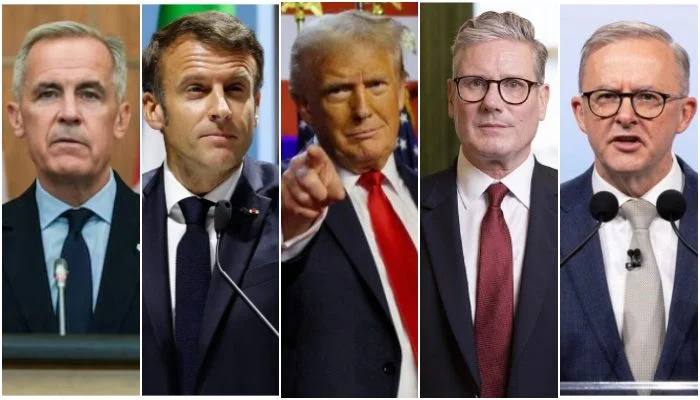
Growing international frustration with Washington over the war in Gaza became evident at the UN General Assembly this week, with key US allies recognizing a Palestinian state in a significant challenge to President Donald Trump’s Middle East policy.
After promising to swiftly end the war between Israel and Hamas at the start of his second term, Trump increasingly appears to be a bystander as Israeli forces intensify their onslaught in the Palestinian enclave. He remains reluctant to rein in Washington’s closest regional ally.
Israeli Prime Minister Benjamin Netanyahu surprised Trump with a strike on Hamas leaders in Qatar earlier this month, a move that all but doomed the Trump administration’s latest effort to secure a Gaza ceasefire and hostage-release deal.
Since then, Israel has launched a ground assault in Gaza City, which the US accepted without objection amid widespread global condemnation of the worsening humanitarian crisis in the coastal strip.
Defying Trump’s warnings against what he called a gift to Hamas, a group of US allies, including Britain, France, Canada, and Australia, announced their recognition of the state of Palestine just before and during the UN gathering, marking a dramatic diplomatic shift.
“Trump has not been able to achieve any major progress or gains in the region, particularly on the Israeli-Palestinian top front,” said Brian Katulis, a senior fellow at the Middle East Institute think-tank in Washington. “In fact, things are worse than when he entered office.”
With an end to the nearly two-year-old conflict seeming more remote than ever, the apparent sidelining of Trump has added to skepticism over his repeated claims since his return to office in January that he is a masterful peacemaker who deserves the Nobel Peace Prize.
French President Emmanuel Macron said on Tuesday that if Trump truly wants to win the coveted Nobel, he needs to stop the war in Gaza. “There is one person who can do something about it, and that is the U.S. president. And the reason he can do more than us is because we do not supply weapons that allow the war in Gaza to be waged,” Macron told France’s BFM TV from New York.
Some analysts see Trump’s unwillingness to apply Washington’s leverage with Netanyahu as a realization that the conflict—like Russia’s war in Ukraine—is far more complex and intractable than he has acknowledged.
Others view it as a tacit acceptance that Netanyahu will act in what he considers his and Israel’s best interests and that there is little the US president can do to change that.
Still others speculate that Trump may have been distracted from the Middle East by domestic issues, such as the recent murder of conservative activist ally Charlie Kirk, the ongoing fallout from the Jeffrey Epstein scandal, and the president’s deployment of National Guard troops to Democratic-led cities for what he describes as crime-fighting missions.
The White House did not immediately respond to a request for comment.
Trump Will Not Be Swayed
Despite appearing less engaged on Gaza recently, Trump met on the sidelines of the UN on Tuesday with leaders from Saudi Arabia, the United Arab Emirates, Qatar, Egypt, Jordan, Turkey, Indonesia, and Pakistan.
Axios reported that he was expected to present U.S. proposals for post-war governance in Gaza, without Hamas involvement, and push for Arab and Muslim countries to agree to contribute military forces to help provide security.
Although Trump has at times expressed impatience with Netanyahu’s handling of the war, he made it clear in his UN speech on Tuesday that he is not ready to back away from strong support for Israel or be swayed by other countries’ endorsement of Palestinian statehood.
Such announcements only serve to “encourage continued conflict” by giving Hamas a “reward for these horrible atrocities,” Trump said.
France, Britain, Canada, Australia, and others have insisted that recognizing a Palestinian state would help preserve the prospects of a “two-state solution” to the long-running conflict between Israel and the Palestinians and help bring an end to the Gaza war.
While leaders taking the podium at the UN gathering did not directly chastise Trump for his stance, some analysts saw a clear message to the US president.
“It all depends on Trump, who could end this war with one choice word to Israel’s prime minister,” said Laura Blumenfeld, a Middle East expert at the Johns Hopkins School for Advanced International Studies in Washington. That word, she said, is “enough.”
The U.S. is Israel’s chief arms supplier and has historically acted as its diplomatic shield at the UN and other world bodies. Last week, the U.S. vetoed a draft Security Council resolution that would have demanded an immediate, unconditional, and permanent ceasefire in Gaza.
However, Trump has given no sign he will use those pressure points. Even after Israel bombed a Hamas office in the territory of U.S. ally Qatar, he held a tense phone call with Netanyahu but took no action. No matter how many countries recognize Palestinian independence, full UN membership would require approval by the Security Council, where the United States holds veto power.
Abraham Accords at Risk?
Still, some analysts did not rule out the possibility that Netanyahu, who is scheduled to visit the White House on Monday for the fourth time since Trump returned to office, may yet exhaust Trump’s patience.
Israel’s strike in Doha dampened Trump’s hopes for more Gulf states joining the Abraham Accords, a landmark agreement brokered by his first administration in which several Arab countries forged diplomatic ties with Israel.
Israel is now considering annexing parts of the occupied West Bank, a move that might be fueled by anger against the international push for the recognition of Palestinian statehood. The most right-wing government in Israel’s history has declared there will be no Palestinian state as it continues its fight against Hamas following its October 7, 2023, attack on Israel, which killed some 1,200 people, according to Israeli tallies. The Israeli military response has killed more than 65,000 people in Gaza, according to local health officials.
The UAE has threatened to suspend its membership in the Abraham Accords—which Trump has long touted as one of his crowning foreign policy successes—if Israel proceeds with West Bank annexation.
Most Middle East experts say such a move would also close the door on the prospects for Gulf power Saudi Arabia ever joining, and that Netanyahu is not likely to go ahead without the green light from Trump, who has been non-committal so far.
“Trump is going to publicly let Netanyahu do what he thinks is right, especially in Gaza,” said Jonathan Panikoff, a former deputy U.S. national intelligence officer on the Middle East. “But privately the president and his team could apply some pressure.”
