

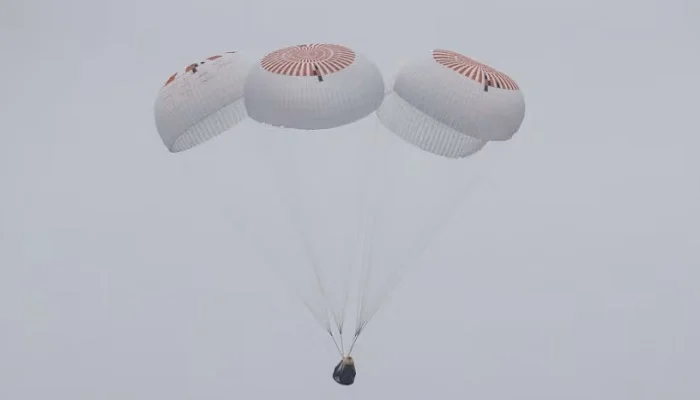
A four-person international crew is back on Earth after nearly five months aboard the International Space Station (ISS), returning safely in a SpaceX capsule on Saturday. The crew, consisting of US astronauts Anne McClain and Nichole Ayers, Japan’s Takuya Onishi, and Russian cosmonaut Kirill Peskov, splashed down off the coast of California at 8:44 am local time.
Their return marks the end of the 10th crew rotation mission to the space station under NASA’s Commercial Crew Program, which was created to partner with private industry to succeed the Space Shuttle era.
The Dragon Capsule’s Return Journey
Billionaire Elon Musk’s SpaceX Dragon capsule detached from the ISS on Friday. According to NASA, when these capsules re-enter Earth’s atmosphere, they heat up to 1,925 degrees Celsius. Atmospheric re-entry, followed by the deployment of huge parachutes, slows the capsule’s speed from 28,100 kilometers per hour to just over 25 kilometers per hour. After the capsule splashed down, a SpaceX ship recovered it, and the crew was finally able to breathe Earth’s air again. The astronauts are now scheduled to fly to Houston to be reunited with their families. During their time on the space station, they conducted numerous scientific experiments, including studies on plant growth, cell reactions to gravity, and the effects of microgravity on human eyes.
A “Bittersweet” Farewell and NASA’s Challenges
NASA Acting Administrator Sean Duffy praised the successful mission, stating, “Our crew missions are the building blocks for long-duration, human exploration, pushing the boundaries of what’s possible.” Astronaut McClain described her farewell to the ISS as “bittersweet” because she may never return. On X, she wrote, “Every day, this mission depends on people from all over the world… it depends on government and commercial entities, it depends on all political parties, and it depends on commitment to an unchanged goal over many years and decades.”
Meanwhile, NASA announced last month it would lose approximately 20% of its workforce—around 3,900 employees—under cuts from US President Donald Trump’s efforts to trim the federal workforce. Despite this, Trump has prioritized crewed missions to the Moon and Mars.
Other Missions and Crew Situations
The Crew-10 launch in March allowed two US astronauts to return home after being unexpectedly stranded aboard the space station for nine months. Butch Wilmore and Suni Williams were initially scheduled for only an eight-day test flight of the Boeing Starliner in June 2024, but the spaceship developed propulsion issues and was deemed unfit to fly back. This week, NASA announced that Wilmore has decided to retire after 25 years of service. Last week, US astronauts Zena Cardman and Mike Fincke, Japan’s Kimiya Yui, and Russian cosmonaut Oleg Platonov boarded the ISS for a new six-month mission.
