

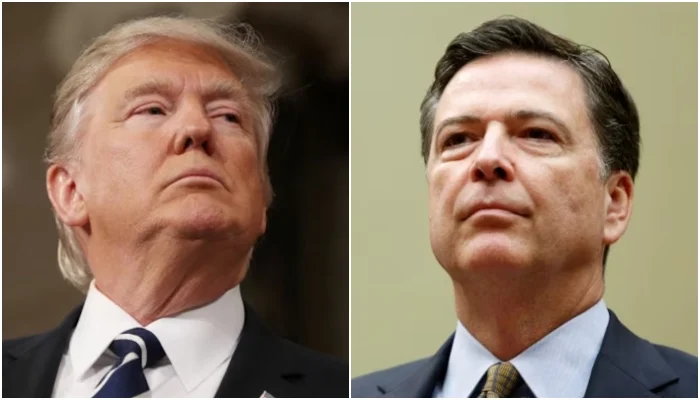
Legal experts suggest that the US criminal case filed against former FBI Director James Comey profoundly shatters long-held norms of independence in federal investigations and is likely to encounter significant legal hurdles in court. However, for President Donald Trump, the final courtroom verdict may be secondary to the act of seeking retribution against an official who previously investigated him, and the powerful warning sent to others he deems political enemies.
Comey, who was indicted on Thursday on charges of false statements and obstruction of a congressional proceeding, was leading the FBI when it commenced an investigation into connections between Trump’s 2016 campaign and the Russian government. Comey has maintained his innocence and pledged to contest the case vigorously in court.
Since returning to office in January, Trump has utilized his presidential powers to weaken law firms that represented causes he opposes, leveraged federal funding to enforce changes at universities, and fired prosecutors involved in investigations against him. He has also pushed for charges against former National Security Advisor John Bolton, New York Attorney General Letitia James, and Democratic Senator Adam Schiff.
When questioned about the Comey indictment on Friday, Trump told reporters, “I think there will be others.” The indictment marks the first instance his administration has employed the power of criminal prosecution against a prominent political adversary. It follows Trump’s open demands for Comey to be charged and his calls for the removal of a prosecutor who did not believe the case was strong.
“The ripple effect from this is huge,” said Rebecca Roiphe, a New York University law professor. “If you are someone who opposes the president or the administration or poses some kind of obstacle to its agenda, you are doing so at grave risk.”
Justice Department leaders have framed the case as a necessary strike against political corruption and the improper use of law enforcement authority. Trump and his allies have long claimed the Russia investigation was a politically biased effort designed to undermine his first administration.
Attorney General Pam Bondi stated, “Today’s indictment reflects this Department of Justice’s commitment to holding those who abuse positions of power accountable for misleading the American people.” Deputy Attorney General Todd Blanche denied any political pressure to indict Comey, telling Fox News that Trump “wants us to do our job.”
Legal Obstacles Ahead
Legal experts indicate that the case against Comey faces several significant legal obstacles to securing a potential conviction. The prosecution is led by Lindsey Halligan, a lawyer who represented Trump in civil litigation and lacks previous prosecutorial experience. In an unusual move, Halligan, whom Trump appointed as US Attorney for the Eastern District of Virginia, personally presented the case to a grand jury, and no career prosecutors in the office signed the indictment, sources told Reuters.
To secure a conviction, prosecutors must prove not only that Comey’s statement was false but also that it had a substantial impact on a Congressional investigation into the FBI’s handling of probes into Trump and his 2016 rival, Democrat Hillary Clinton. The indictment alleges that Comey lied when he told Republican Senator Ted Cruz in 2020 that he stood by prior testimony claiming he had not authorized anyone at the FBI to be an anonymous source in news reports.
The indictment does not specify the investigation or news report in question, but a source familiar with the matter told Reuters it relates to Comey’s alleged authorization for his friend, law professor Daniel Richman, to share information about a Clinton-related investigation. Bradley Moss, a lawyer specializing in national security cases, commented, “The underlying premise of the false statement charge is at best incredibly thin.”
Another potential hurdle is Trump’s own intervention. Halligan’s predecessor, Erik Siebert (also a Trump appointee), resigned under pressure after expressing misgivings about the case. Trump then publicly demanded “JUSTICE MUST BE SERVED, NOW!” in a social media post mentioning Comey by name. After the indictment, Trump wrote of Comey, “HE LIED” and “there is no way he can explain himself out of it.”
Such statements could serve as ammunition for a defense argument that the prosecution is vindictive or selective, implying Comey was improperly targeted. While legal experts note that such defenses are challenging to win, the detailed record of Trump’s statements and actions could give Comey a strong foundation for this argument.
A Broader Warning
The indictment of Comey comes as the Justice Department is also pursuing mortgage fraud investigations into Letitia James and Adam Schiff, both of whom have played roles in investigations concerning Trump. John Bolton is currently under investigation for the potential mishandling of classified documents. All three individuals have denied any wrongdoing.
Critics of the administration fear the Comey indictment may foreshadow a wider effort to use criminal law against Trump’s political rivals and critics, forming part of a broader strategy to intimidate adversaries and stifle dissent. The action also breaks with decades-old Justice Department norms requiring that criminal investigations be shielded from political pressure. An indictment risks a defendant’s freedom, and even mounting a successful defense can incur massive legal costs.
Trump successfully campaigned in 2024 partly on a vow of political retribution against those he claimed had improperly targeted him and his political movement. Trump, who faced four criminal indictments during his years out of power, has consistently argued that the legal system was wrongly weaponized against him.
In July, the White House X account posted an image of Trump against a backdrop of fireworks and American flags, with the text: “I was the hunted. NOW I’M THE HUNTER.“
