

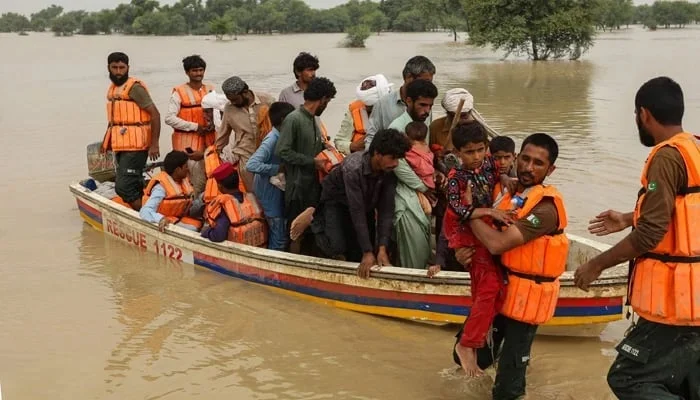
In the latest act of water aggression, India’s unexpected release of excess water into the Sutlej River has caused flooding in Kasur’s Ganda Singh Wala, leading to the submersion of villages and the destruction of thousands of acres of farmland. According to officials, rescue operations are underway to move villagers and their livestock to safety.
In Burewala, floodwaters have spread through the Sahu Ka area and nearby rural communities, submerging agricultural land and isolating hundreds of villages after a breach on the Sahu Ka–Chishtian road. Dozens of farming families in Bahawalpur and Bahawalnagar watched helplessly as their main crops—cotton, rice, and sesame—were swept away, destroying their livelihoods. Moreover, panicked villagers have been forced to abandon their ancestral homes, carrying what they can and wading through waist-deep water to find shelter.
According to the Flood Forecasting Division in Lahore, a medium-level flood is passing through Head Sulemanki. The Chenab River is also rising, with a low-level flood recorded at Marala and Khanki. In the Indus River, moderate flooding is being reported at the Guddu and Sukkur barrages, while at Tarbela, Kalabagh, and Chashma, the water levels are high enough to cause a low-level flood situation, the division stated.
Meanwhile, breaking a long silence since their May military standoff, India has contacted Pakistan through the Indus Waters Treaty (IWT) to share details on potential flood threats, official sources said on Monday. According to these sources, New Delhi warned Pakistan of a possible major flood in the Tawi River at Jammu. The Indian High Commission in Islamabad conveyed the alert in a communication on the morning of August 24. This is the first significant contact of its kind since the Pakistan-India war in May, the sources noted. Following the alert, Pakistani authorities issued warnings based on the information provided by India.
In the aftermath of the killing of 26 people in the Pahalgam area of Indian Illegally Occupied Jammu and Kashmir (IIOJK) in April, India had held the IWT with Pakistan in abeyance. New Delhi accuses Islamabad of orchestrating the deadly militant attack, an allegation that Pakistan denies. Based on these baseless allegations, India waged a war against Pakistan in May, resulting in the heaviest military engagement in decades, before a ceasefire was brokered by the US. The nuclear-armed neighbors have a long-standing disagreement over the use of water from rivers that flow from India into the Indus River basin in Pakistan. The use of this water is governed by the IWT, which was mediated by the World Bank and signed by both nations in September 1960. There is no provision in the treaty for either country to unilaterally suspend or terminate the pact, which has clear dispute resolution systems. The treaty has survived three wars and other conflicts between the two rivals, and has
