

Riew, Arunachal Pradesh, India
On a remote football field framed by misty Himalayan mountains, the air resonated with defiant speeches as local tribesmen protested a planned mega-dam, the latest move in India’s escalating contest with China over shared water resources.
India argues the proposed new structure is a necessary countermeasure to China’s massive project upstream in Tibet. The dam is intended to stockpile crucial water and guard against the potential release of ‘weaponised torrents’ from its rival’s likely record-breaking dam.
But for the indigenous communities residing at one of the dam’s proposed sites, the project feels like a profound threat to their existence.
“We will fight till the end of time,” declared Tapir Jamoh, a resident of the thatch-hut village of Riew, raising a bow loaded with a poison-tipped arrow in a traditional gesture of defiance against authorities. “We will not let a dam be built.”
Jamoh’s homelands belong to the Adi people in the far-flung northeastern corner of India, separated from Tibet and Myanmar by soaring, snowy peaks.
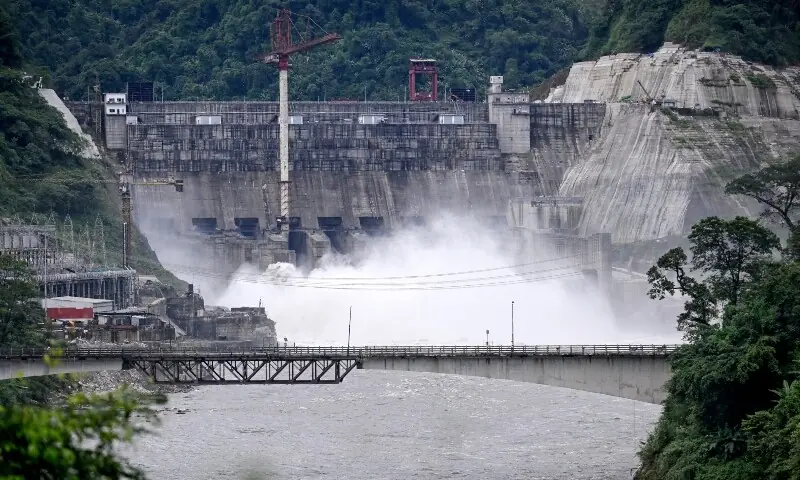
Proposed blueprints show India is considering the site in Arunachal Pradesh for a massive storage reservoir, capable of holding the equivalent of four million Olympic-size swimming pools behind a 280-metre (918-foot) high dam.
This ambitious project directly responds to China’s pursuit of the $167 billion Yaxia project upstream of Riew on the river known in India as the Siang, and in Tibet as the Yarlung Tsangpo. China’s plan involves five hydropower stations that could generate three times more electricity than its own vast Three Gorges dam—currently the world’s largest power station—though specific details remain scant.
Beijing—which maintains a territorial claim over Arunachal Pradesh, a claim rejected by India—insists its project will have no “negative impact” downstream. China’s foreign ministry stated: “China has never had, and will never have, any intention to use cross-border hydropower projects on rivers to harm the interests of downstream countries or coerce them.”
Despite a recent thaw in relations, the two most populous nations maintain multiple areas of disputed border manned by tens of thousands of troops, and India has made its concerns public. The river is a major tributary of the mighty Brahmaputra, and Indian officials fear China could use its dam as a control tap—to engineer deadly droughts or unleash a devastating “water bomb” downstream.
China dismisses these fears, stating that the “hype surrounding the Yaxia Hydropower Project as a ‘water bomb’ is groundless and malicious.”
However, Arunachal Pradesh state Chief Minister Pema Khandu has framed protective action against China’s dam as a “national security necessity,” viewing India’s counter-dam as a crucial safety valve to control the water flow.
“China’s aggressive water resource development policy leaves little room for downstream riparian nations to ignore it,” noted Maharaj K. Pandit, a Himalayan ecology specialist at the National University of Singapore.
Locals like 69-year-old Jamoh view the conflict in starkly personal terms, arguing that damming the Siang would erase their culture and identity. Beyond the geopolitical stakes, India’s dam could generate up to 11,600 MW, potentially becoming its most powerful and significantly cutting reliance on coal.
