

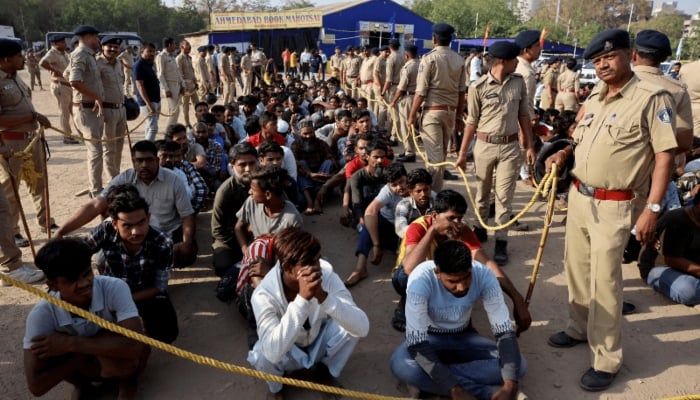
India has recently undertaken a widespread campaign of deporting hundreds of people without trial to neighboring Bangladesh. While New Delhi asserts these individuals are undocumented migrants, the actions have drawn strong condemnation from activists and lawyers who label the expulsions as illegal, lacking due process, and based on ethnic profiling, particularly targeting Bengali-speaking Muslims.
Deportation and Detention Statistics:
- Hundreds deported without trial: Officials from both India and Bangladesh confirm hundreds of expulsions.
- Bangladesh’s claims: Bangladesh states India has pushed over 1,600 people across its border since May.
- Indian media estimates: Some Indian media reports suggest the number of deportations could be as high as 2,500.
- Bangladesh Border Guards’ response: They have sent back 100 of those pushed across, asserting that these individuals were Indian citizens.
- State-specific figures:
- Assam’s Chief Minister confirmed over 300 people have been deported to Bangladesh from Assam.
- Gujarat’s police chief reported more than 6,500 people were rounded up in Gujarat, with many Bengali-speaking Indians later released.
- Delhi Police identified approximately 900 illegal Bangladeshi nationals for deportation, and around 700 undocumented migrants have been repatriated from Delhi in the past six months.
- “Operation Sindoor”: Since this operation began in early May, over 2,000 alleged illegal Bangladeshi immigrants have been “pushed back.” An additional 2,000 are estimated to have voluntarily left due to fear of detention.
Targeting and Allegations of Ethnic Profiling:
- The campaign is primarily seen as targeting Muslims, particularly Bengali speakers, a linguistic group prevalent in both eastern India and Bangladesh.
- Critics, including veteran Indian rights activist Harsh Mander, describe this as an “ideological hate campaign” that instills “existential fear” among millions of Indian Muslims.
- Many of those targeted are low-wage laborers in states governed by Prime Minister Narendra Modi’s Bharatiya Janata Party (BJP).
- Reports indicate individuals with valid Indian identity documents (Aadhaar, PAN, voter cards) have been picked up, abused, and forcibly pushed across the border. Some were allegedly stripped of their documents, phones, and cash.
- There are accounts of Indian security forces allegedly beating individuals who insisted they were Indian citizens.
Human Rights and Legal Concerns:
- Lack of due process: Lawyers argue that Indian law does not permit deportations without proper legal process, including due diligence and hearings.
- “Push-back” practice: This refers to the informal and forced deportation of undocumented migrants without following judicial or diplomatic procedures, often at gunpoint.
- No acceptance by receiving country: Critics highlight that people cannot be deported unless there is a country willing to officially accept them. Bangladesh has formally protested these “push-ins.”
- Abuse and inhumane treatment: There are distressing reports of individuals being held for days, forced into swampland in the dark, thrashed by border police, and facing gunfire when attempting to return to India.
- Violation of international law: Rights organizations like Amnesty International assert that these actions violate international conventions, including the Universal Declaration of Human Rights and the International Covenant on Civil and Political Rights, to which India is a signatory.
Broader Context of Immigration and India’s Stance:
- Hardline stance: Prime Minister Narendra Modi’s Hindu nationalist government has consistently taken a hardline stance on immigration, especially from Muslim-majority Bangladesh, often referring to them as “termites” and “infiltrators.”
- Post-attack crackdown: India intensified operations against migrants following a terror attack in Indian Illegally Occupied Jammu and Kashmir (IIOJK) on April 22, which killed 26 people. While India blamed Pakistan, these claims led to a four-day conflict.
- Estimated undocumented migrants: The Indian government in 2016 estimated around 20 million undocumented migrants from Bangladesh.
- Citizenship Amendment Act (CAA): This act, which came into force last year, distinguishes between Hindu migrants (considered “refugees” to be sheltered and conferred citizenship) and Muslim migrants (deemed “infiltrators” to be pushed back), solidifying the ideological dimension of India’s immigration policy.
Rohingya Refugees and Deportations:
- India has also been accused of forcibly deporting Muslim Rohingya refugees from Myanmar.
- Reports indicate that Indian naval ships have dropped Rohingya refugees off the coast of the war-torn nation, with recent allegations of at least 40 Rohingya refugees being deported by forcing them off a naval ship, and over 100 forced across the border into Bangladesh in the last month.
- India does not recognize UNHCR-issued refugee cards for Rohingya, viewing them under the Foreigners Act, which allows for forced deportations.
- India is not a signatory to the 1951 UN Refugee Convention, which means it handles refugees according to its national laws rather than international refugee law principles. However, Amnesty International argues that India is still bound by the principle of ‘non-refoulement’ under customary international law, which prohibits returning individuals to places where they face a real risk of serious human rights violations.
The deportations are straining relations between India and Bangladesh, particularly after a recent uprising in Bangladesh led to the downfall of its former pro-India government. Bangladesh has formally protested India’s actions and called for resolution through legal and diplomatic channels.
