

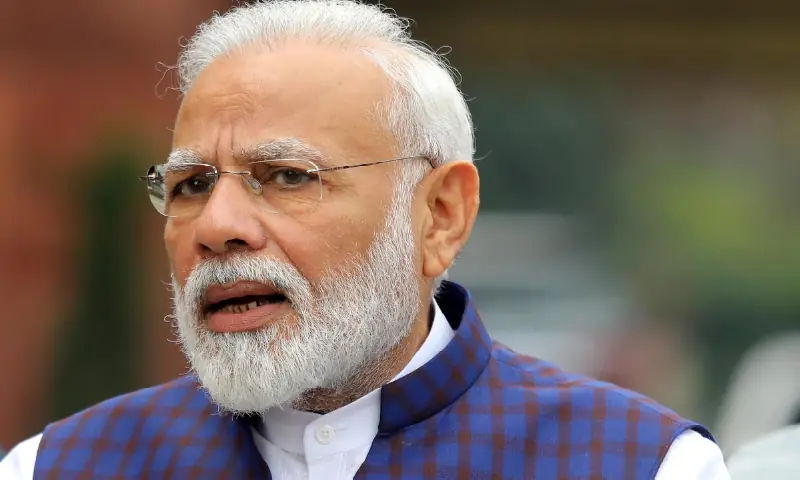
NEW DELHI/ISLAMABAD – India’s foreign policy has taken a sharp turn, signaled by Prime Minister Narendra Modi’s decision to skip this year’s UN General Assembly session. While no official explanation was provided for his absence, clear evidence suggests the decision was precipitated by US President Donald Trump openly shifting his preference from India to Pakistan as a closer partner in South Asia.
The established protocol of Modi always meeting the US President during his UN visits was jeopardized. The primary deterrent was not necessarily a signal of disinterest from Trump, but rather the highly visible optics of Pakistan’s prime minister and army chief appearing in “cosy frames” with the US President, which was interpreted as the final catalyst for the Indian PM’s withdrawal from the visit.
Representing India at the UN, External Affairs Minister S. Jaishankar articulated a philosophy centered on self-reliance, self-protection, and self-confidence. Jaishankar, leaning into Hindu nationalist sentiment, emphasized these three mantras in Sanskrit and insisted on using the name “Bharat” for India.
Revisiting the US Relationship and China Overture
Modi had previously shown a willingness to navigate the political cloud of tariffs and verbal attacks from Trump, keeping trade talks open in the calculated hope that US policymakers would recognize the risk of New Delhi moving closer to Beijing. This calculation, however, appears to have been overestimated by India.
In response, the Indian Prime Minister made a concerted effort to signal an alternative scenario. His meeting with Chinese President Xi Jinping at the SCO summit in Tianjin was notably effusive. Modi spoke of the “atmosphere of peace and stability” following border disengagement and emphasized the cooperation linked to the interests of billion people of the two countries.
However, during his SCO speech, Modi made a clear but unnamed reference to a sensitive issue with China. He insisted that “every effort towards connectivity must uphold the principles of sovereignty and territorial integrity.” The remark was a clear, yet diplomatically veiled, reference to India’s long-standing dispute over the Karakoram Highway and the Shaksgam Valley, which Pakistan ceded to China in .
Strengthening Ties with Russia and Iran
Signaling a strategic hedge, Modi made a similar pitch to Russian President Vladimir Putin, noting: “India and Russia have always stood shoulder-to-shoulder even in the most difficult situations.” He confirmed that he was looking forward to receiving Putin in New Delhi in December.
Modi added another layer of complexity to the diplomatic mix by highlighting India’s engagement with Iran’s Chabahar Port, a move the US views with skepticism. The geopolitical twist lies in the fact that Pakistan is also heavily invested in flourishing ties with all three nations—the US, Russia, and China—that India is now seeking to court, intensifying the rivalry for influence in the region.
