

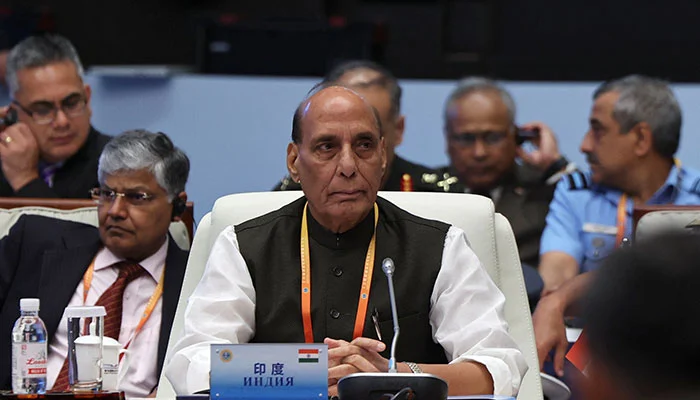
India on Thursday, as reported by local media, refused to sign a joint document during a high-level Shanghai Cooperation Organisation (SCO) meeting held in China. The refusal stemmed from the document’s mention of terrorist activities in Pakistan’s Balochistan and the lack of reference to the Pahalgam incident, which saw several tourists killed in Indian Illegally Occupied Jammu and Kashmir (IIOJK).
According to the Times of India, Indian Defence Minister Rajnath Singh attended the SCO Defence Ministers’ meeting in Qingdao, which brought together ministers from 10 member states, including Russia, China, India, and Pakistan. The huddle ultimately decided not to issue a joint statement due to a lack of consensus on the terrorism issue.
This development follows a clarification from Pakistan’s Foreign Office a day earlier, stating that Defence Minister Khawaja Asif would represent Islamabad at the SCO moot, but there was no scheduled meeting between him and his Indian counterpart, Singh. This clarification came after claims by Turkish media suggesting a possibility of a meeting between Pakistani and Indian defence ministers – which would have been the first such interaction since the recent armed conflict between the two nuclear-armed neighbors involving cross-border strikes.
Earlier, National Security Advisor (NSA) Lt Gen Asim Malik attended the 20th meeting of the secretaries of the Security Council of SCO Member States on Tuesday in Beijing, China. During his visit, the NSA not only interacted with the Chinese leadership but also delivered a significant speech reiterating Pakistan’s stance on global and regional security, and its contributions to peace. He also held meetings with key leadership of SCO countries to enhance bilateral and security cooperation.
Speaking at the SCO meeting, Singh emphasized New Delhi’s concerns regarding terrorism and urged member countries to adopt a principled stance on the matter, as reported by NDTV. “The biggest challenges in our region are related to peace, security and trust deficit,” the Indian defence minister stated. “India believes that reformed multilateralism can help build cooperation to prevent conflict between countries by creating mechanisms for dialogue and collaboration.”
