

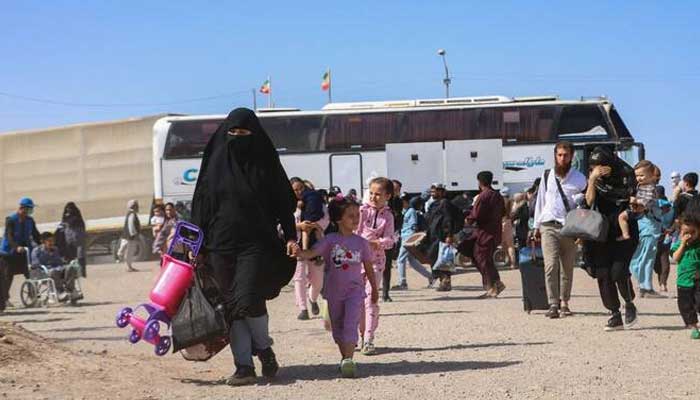
The United Nations announced on Thursday that Taliban authorities are committing human rights violations, including torture and arbitrary detention, against Afghans forcibly returned by Iran and Pakistan. Large-scale deportation campaigns launched by Iran and Pakistan have compelled millions of Afghans to return to Afghanistan, with over 1.9 million individuals repatriated so far in 2025, the vast majority from Iran.
In a statement accompanying the release of its report, the UN stated, “People returning to the country who were at particular risk of reprisals and other human rights violations by the de facto (Taliban) authorities were women and girls, individuals affiliated with the former government and its security forces, media workers, and civil society.” The statement added that “these violations have included torture and ill-treatment, arbitrary arrest and detention, and threats to personal security.”
The UN’s refugee agency (UNHCR) recently estimated that up to three million people could return to Afghanistan in 2025, to a nation grappling with a severe humanitarian crisis. The report, compiled by the UN Assistance Mission in Afghanistan and the UN Human Rights Office, was based on interviews with 49 repatriated Afghans. It indicated that violations have been committed against Afghans “based on their specific profile,” including women, media workers, and members of civil society, as well as individuals associated with the former foreign-backed government that collapsed in 2021.
The Taliban government has previously denied allegations of abuse, having declared an amnesty for those who worked for NATO forces and the former government during their two-decade conflict against the Taliban’s insurgency. UN rights chief Volker Turk stated earlier this month, “Nobody should be sent back to a country where they face risk of persecution on account of their identity or personal history.” He further elaborated, “In Afghanistan, this is even more pronounced for women and girls, who are subjected to a range of measures that amount to persecution on the basis of their gender alone.”
‘Gender Apartheid’ Concerns
Over the past four years, women have been increasingly isolated from public life by the Taliban authorities, who have banned them from universities, public parks, gyms, and beauty salons—a situation the UN has denounced as “gender apartheid.” Russia is the sole country that has recognized the Taliban government since it seized power in 2021 following the withdrawal of foreign troops from the country. Neighboring Tajikistan has followed Islamabad and Tehran’s example by announcing its intention to expel Afghans. UNHCR informed AFP that at least 377 individuals have been deported since July 8.
Meanwhile, Germany deported 81 Afghan men last week who had committed crimes, and the United States announced it would revoke the temporary protection status for thousands of Afghans. According to the UN, the recent surge in returnees has created a ‘multi-layered human rights crisis,’ and the organization last week called for an “immediate halt” to forcible returns.
