

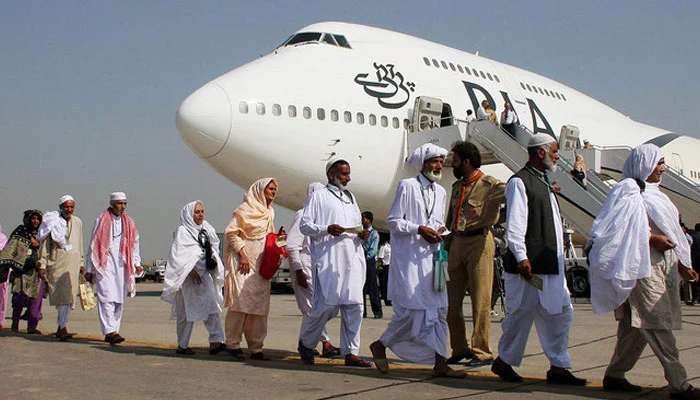
Minister for Religious Affairs, Sardar Muhammad Yousuf, has announced that the government will begin accepting Hajj applications from August 4th, as reported by The News on Thursday. Detailing the Hajj Policy 2026, which received federal cabinet approval earlier in the day, he stated that Pakistan’s pilgrim quota will remain at 179,210, with 119,210 pilgrims performing Hajj under the government’s regular scheme.
The minister clarified that the quota for the private scheme has been reduced by 50% to 60,000, meaning two-thirds of the total quota has been allocated to the government scheme. Consequently, the government scheme’s quota stands at 66.52%, while the private scheme’s quota is 33.48%.
Under the government scheme, the total Hajj expenses will range between Rs1,150,000 and Rs1,250,000, with the first installment of Rs500,000 to be deposited in the first week of August. A 20 to 25-day Hajj package will also be offered under the government scheme. Pilgrims who registered earlier, as per ministry directives, will be given priority.
When questioned about the reduction in the private scheme quota, especially after the Senate’s sub-committee attributed the lapse of last year’s quota to the ministry, Sardar Yousuf responded that the ministry was not consulted during the report’s compilation. He added that the private operators’ quota was reduced to enable them to better manage their allocation and provide improved services.
The Secretary of the Ministry of Religious Affairs stated that the ministry’s portal will cease accepting applications once the government scheme’s quota is filled.
Meanwhile, a senior official from the Ministry of Religious Affairs informed the Senate standing committee on Wednesday that the government is consulting on sea travel for Zaireen to Karbala for Arbaeen. Senator Attaur Rehman chaired the meeting, which addressed matters related to Hajj 2025 and the ban on road travel for Zaireen to Karbala. Senator Raja Nasir Abbas emphasized that it is the government’s responsibility to safeguard the religious rights of Zaireen wishing to visit Karbala for Arbaeen. The minister further assured that all concerns would be addressed.
Comprehensive Digitization of the Hajj Process
The approved Hajj Policy 2026 mandates the complete digitization of the pilgrimage process, commencing in 2026. Seventy percent of pilgrims will be accommodated under the government scheme, while 30% will utilize private operators, who will now face more stringent accountability. Private Hajj companies that failed to deliver in the previous year are now required to facilitate the same pilgrims in 2026.
Key improvements include real-time tracking, digital wristbands, mobile applications, SIM cards, and a revamped compensation mechanism. The Ministry of IT will collaborate with the Ministry of Religious Affairs to ensure the digital transformation of Hajj operations.
Addressing significant developments, Yousaf acknowledged the failure of some private Hajj tour operators to deposit pilgrims’ payments on time, which led to complications last year. To rectify this, private tour operators will now offer Hajj to affected pilgrims based on last year’s costs.
He further stated that a financial eligibility criterion has been introduced for private operators to ensure transparency, and a neutral third party will monitor both public and private Hajj schemes.
The Hajj selection process will now operate on a first-come, first-served basis, and only pilgrims with Saudi-approved vaccinations will be permitted. The “Road to Makkah” facility will be accessible at Islamabad and Karachi airports. Additionally, the ministry will provide comprehensive training to pilgrims and establish emergency response teams. An effective financial oversight system and a transparent grievance redressal mechanism will also be implemented. Furthermore, the Hajj Nazim Scheme will continue, and children under 12 years of age will not be allowed to perform Hajj.
