

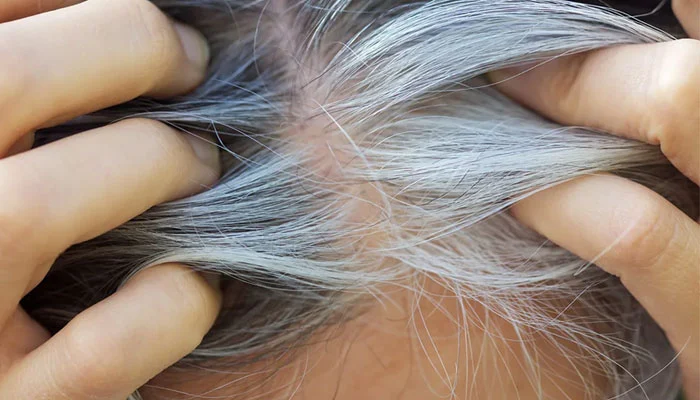
TOKYO – Japanese scientists have discovered an unexpected and profound link between graying hair and the body’s sophisticated defense mechanism against cancer. The new research suggests that hair turning white is not merely a sign of aging, but is actually a protective response to prevent tumors.
The study, led by Professors Emi Nishimura and Yasuki Mohri of Tokyo University, used mice to examine how stem cells in hair follicles respond to different types of stress.
The key players are the “melanocyte stem cells,” which reside in our hair follicles and are responsible for giving hair its color. Over time, these cells accumulate DNA damage from everyday factors like sunlight (UV radiation), chemicals, or simple wear-and-tear.
According to the research, when these cells sense this “stress” or damage, they take a “safe” path. They are programmed to quickly mature and, crucially, stop dividing. In this process, they lose their ability to produce pigment, which results in the hair turning gray. Scientists say this is the body’s defense mechanism to stop cells with faulty DNA from multiplying.
The danger, however, arises when this protective system fails.
If the stress comes from a carcinogen (like UV-B radiation) and it is combined with a specific signal from nearby tissue (known as KIT ligand), that signal can override the cell’s protective response (the p53-p21 response).
In this scenario, the cells with damaged DNA do not stop and turn gray. Instead, they bypass the safety check and begin to divide uncontrollably, proliferating and spreading. These same cells that once only produced color can now become the origin of melanoma, a dangerous form of skin cancer.
The scientists clarified that graying hair is not a sign of cancer. Rather, it is a sign that your body is successfully taking precautions against it. Cancer is what happens when those precautions fail.
