

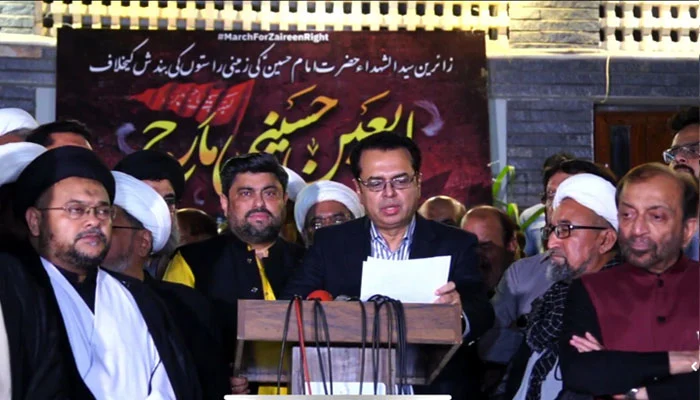
In a major development, the Majlis Wahdat-e-Muslimeen (MWM) and the Shia Ulema Council have called off their planned march from Karachi’s Ancholi to the Pakistan-Iran border. This decision came after successful negotiations with the federal government led to a seven-point agreement. The consensus was announced during a joint press conference in Karachi, attended by Sindh Governor Kamran Tessori, Minister of State for Interior Talal Chaudhry, and MWM leader Allama Raja Nasir Abbas Jafri.
Speaking at the press conference, which followed late-night talks facilitated by Governor Tessori, Minister Chaudhry confirmed that the government and MWM leadership had reached a seven-point understanding. He expressed gratitude to the MWM leadership for ending the protest march, clarifying that the Taftan border has not been, and will not be, closed to pilgrims.
Chaudhry also announced that visa extensions of up to 60 days would be facilitated in coordination with Iraqi authorities, and discounted flights would be arranged for those who still plan to travel. The government has committed to ensuring refunds for payments made by pilgrims who had booked overland travel with tour operators and transport companies. While advising against land travel this year due to security concerns, the minister confirmed that the Taftan-Rimdan border would remain open.
MWM Vice Chairman Allama Ahmed Iqbal Rizvi, also present at the conference, thanked the minister and governor for their positive role in addressing the difficulties caused by the land travel ban. He announced the end of the Arbaeen protest march, stating that they would monitor the progress on the understanding reached with the government. He specifically thanked the governor for facilitating the talks and acting as the guarantor for the MWM. Rizvi also called on the federal government to provide discounted air tickets to pilgrims who had already obtained visas. The governor concluded by stating that all parties had agreed to resolve issues through dialogue rather than protests.
Previously, Interior Minister Mohsin Naqvi had announced that due to security concerns, Pakistani pilgrims would not be allowed to travel to Iran or Iraq by road for this year’s Arbaeen pilgrimage. Annually, approximately 700,000 Pakistani pilgrims travel to Iraq for Arbaeen, which marks the 40th day of mourning for the martyrdom of Hazrat Imam Hussain (RA).
