

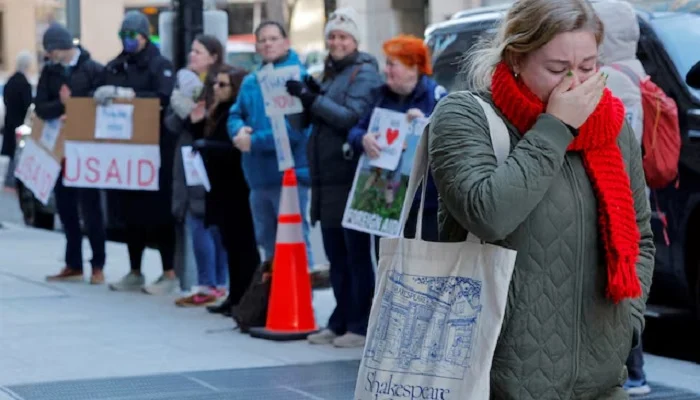
A research study released on Tuesday, July 1, 2025, projects that over 14 million of the world’s most vulnerable people, a third of whom are young children, could die by 2030 due to the Trump administration’s dismantling of US foreign aid. This alarming study, published in the prestigious Lancet journal, comes as world and business leaders convene for a UN conference in Spain this week, aiming to bolster the struggling aid sector.
The US Agency for International Development (USAID) had historically provided over 40% of global humanitarian funding until Donald Trump’s return to the White House in January. Just two weeks later, Trump’s then-close advisor—and the world’s richest man—Elon Musk reportedly boasted of having put the agency “through the woodchipper.”
Davide Rasella, a researcher at the Barcelona Institute for Global Health (ISGlobal) and co-author of the study, warned that the funding cuts “risk abruptly halting—and even reversing—two decades of progress in health among vulnerable populations.” He stated, “For many low- and middle-income countries, the resulting shock would be comparable in scale to a global pandemic or a major armed conflict.”
Analyzing data from 133 nations, the international team of researchers estimated that USAID funding had prevented a remarkable 91 million deaths in developing countries between 2001 and 2021. They then used modeling to project the potential impact of an 83% cut in funding—the figure announced by the US government earlier this year—on death rates. The projections indicate that these drastic cuts could lead to more than 14 million avoidable deaths by 2030. This figure includes over 4.5 million children under the age of five, translating to approximately 700,000 child deaths annually. For context, an estimated 10 million soldiers were killed during World War I.
The researchers found that programs supported by USAID were linked to a 15% decrease in deaths from all causes. For children under five, the drop in deaths was even more significant, at 32%. USAID funding proved particularly effective in staving off preventable deaths from disease. The study revealed a 65% reduction in deaths from HIV/AIDS in countries receiving a high level of support compared to those with little or no USAID funding. Deaths from malaria and neglected tropical diseases were similarly cut in half.
An Urgent Call to Scale Up
Following the significant reduction in USAID funding, several other major donors, including Germany, the UK, and France, also announced plans to cut their foreign aid budgets. Caterina Monti of ISGlobal, another co-author, cautioned that these aid reductions, particularly within the European Union, could lead to “even more additional deaths in the coming years.”
However, the grim death projections are based on the current amount of pledged aid, and researchers emphasized that these figures could rapidly decrease if the situation changes. Dozens of world leaders are currently gathered in the Spanish city of Seville this week for the largest aid conference in a decade. Notably, the U.S. will not be attending.
“Now is the time to scale up, not scale back,” urged Rasella. Before its funding was slashed, USAID represented a mere 0.3% of all US federal spending. James Macinko of the University of California, Los Angeles, a study co-author, highlighted, “US citizens contribute about 17 cents per day to USAID, around $64 per year. I think most people would support continued USAID funding if they knew just how effective such a small contribution can be to saving millions of lives.
