

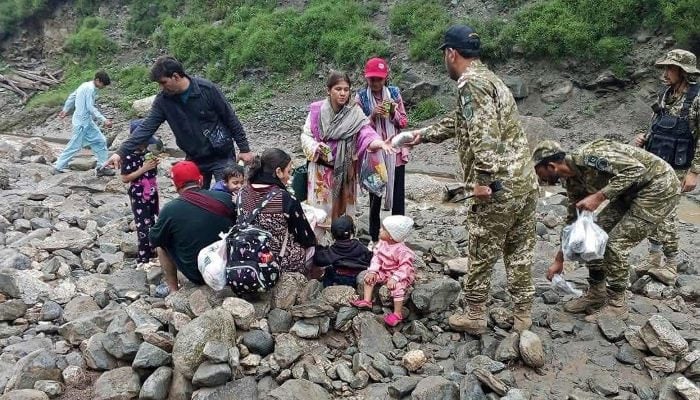
Gilgit Baltistan has been severely impacted by a series of climate-driven disasters over the past two weeks, resulting in at least nine confirmed fatalities, damage to over 200 homes, and significant infrastructure destruction. Chief Secretary Abrar Ahmed Mirza stated that the region, nestled in northern Pakistan, has experienced extreme weather conditions, with glacial melts, heatwaves, and heavy rainfall triggering flash floods and landslides, as reported by The News.
Addressing a press briefing on Thursday, the top official explained that the region initially faced glacial melt and heatwaves, followed by a new spell of heavy rains that instigated flash floods and landslides, particularly in the Diamer and Astore districts. “From June 10 till now, we have confirmed nine fatalities, eight of which occurred in the valleys of Thak and Thor in Diamer, while one death was reported from Astore valley,” he stated. The chief secretary noted that most incidents were caused by Glacial Lake Outburst Floods (GLOFs), a phenomenon increasingly common due to rising temperatures and climate change. He added, “We are witnessing the compounded impact of extreme heat and erratic rainfall.”
He further detailed that the floods have damaged approximately 200 homes, disrupted roads and water channels, and cut off several villages in the Kharmang district, where bridges collapsed. “All 10 districts of Gilgit Baltistan have been affected to varying degrees, but Diamer remains the hardest hit,” he emphasized. According to Mirza, the government promptly launched rescue operations in collaboration with the Pakistan Army, GB Scouts, district administration, and Rescue 1122, aided by local volunteers. Stranded tourists were also airlifted via army helicopter sorties in inaccessible areas. He acknowledged that travel advisories are regularly issued for high-risk areas but noted that the public response remains inadequate. “People tend not to alter their travel plans until the threat becomes imminent,” he observed.
He further warned that the death toll may increase, as several vehicles are still missing, and four to five more bodies are feared to be found during ongoing recovery efforts. The GB government continues to assess the full scale of the damage and has pledged to restore blocked routes and provide relief to displaced families.
Nationwide Monsoon Impact: Death Toll Reaches 258
Meanwhile, at least six people were killed and five others injured due to heavy rainfall across the country in the past 24 hours, pushing the country’s death toll from the monsoon spell to 258, according to the National Disaster Management Authority (NDMA).
The agency reported on Thursday that three of the fatalities occurred in Khyber Pakhtunkhwa, where five individuals were also injured. Additionally, two people died in Islamabad and one person in Sindh as a result of rain-related incidents. Among the deceased are 89 men, 46 women, and 123 children. The injured include 243 men, 170 women, and 203 children, highlighting the widespread human toll caused by the ongoing weather emergency.
The rains have also caused extensive property and livestock damage. Over the last 24 hours alone, 22 houses were reported destroyed, and 36 livestock animals perished. Since the beginning of the monsoon season, a total of 1,027 houses have been demolished by the rains, while 364 animals have died.
