

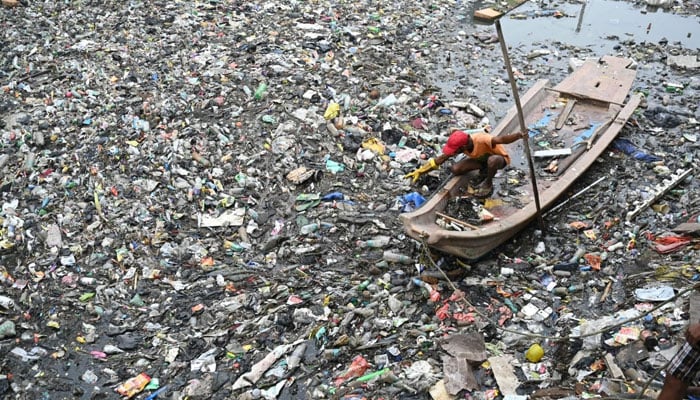
As delegates from over 170 countries gather in Geneva for a crucial round of talks, a prominent marine litter expert is urging them to finalize an ambitious global agreement on plastic pollution. According to The Guardian, Professor Richard Thompson, who first coined the term ‘microplastics’, emphasized that decisive action is necessary to safeguard human health and the planet for future generations.
Thompson, who was named one of Time’s 100 most influential people this year, is attending the talks as the coordinator of the ‘Scientists’ Coalition for an Effective Plastics Treaty’. He stated, “It is really clear that to protect future generations, we need to take decisive action now on a treaty to address plastic pollution. So I really hope negotiators can look the next generation in the eye and say they acted decisively.”
Thompson’s call comes amidst significant divisions among nations on whether to include legally binding limits on plastic production in the final treaty. Negotiations in Busan, South Korea, last November failed to reach an agreement on this issue. While more than 100 countries support legally binding reductions, nations with major fossil fuel industries, such as Saudi Arabia, Russia, and China, are advocating for a treaty focused on improved waste management and recycling. The United States has also signaled support for a less ambitious agreement.
The urgency of the situation was highlighted by a recent report that warned the world is in a “plastics crisis,” causing disease and death and incurring at least $1.5 trillion a year in health-related costs. The Guardian reported that plastic production has increased more than 200-fold since 1950 and is projected to nearly triple again by 2060. This growth is primarily driven by the production of single-use plastics, especially for packaging and containers.
Globally, only 9% of plastic is recycled. Thompson, whose work led to the UK’s ban on microbeads in cosmetics, argues that evidence shows a reduction in plastic production is essential to combat plastic pollution. He believes a treaty must ensure that only essential plastics are produced, the thousands of chemicals used are minimized, and a circular economy of reuse is adopted.
Thompson also noted that while some countries view production cuts as an economic threat, “business-as-usual is not sustainable.” Graham Forbes, Greenpeace’s head of delegation to the treaty negotiations, echoed this sentiment, stating: “Uncontrolled plastic production is a death sentence. The only way to end plastic pollution is to stop making so much plastic.” He urged world leaders to “seize the opportunity in Geneva, stand up to the fossil fuel industry and take humanity’s first step towards ending the plastics crisis and create a healthier, safer future for all.”
