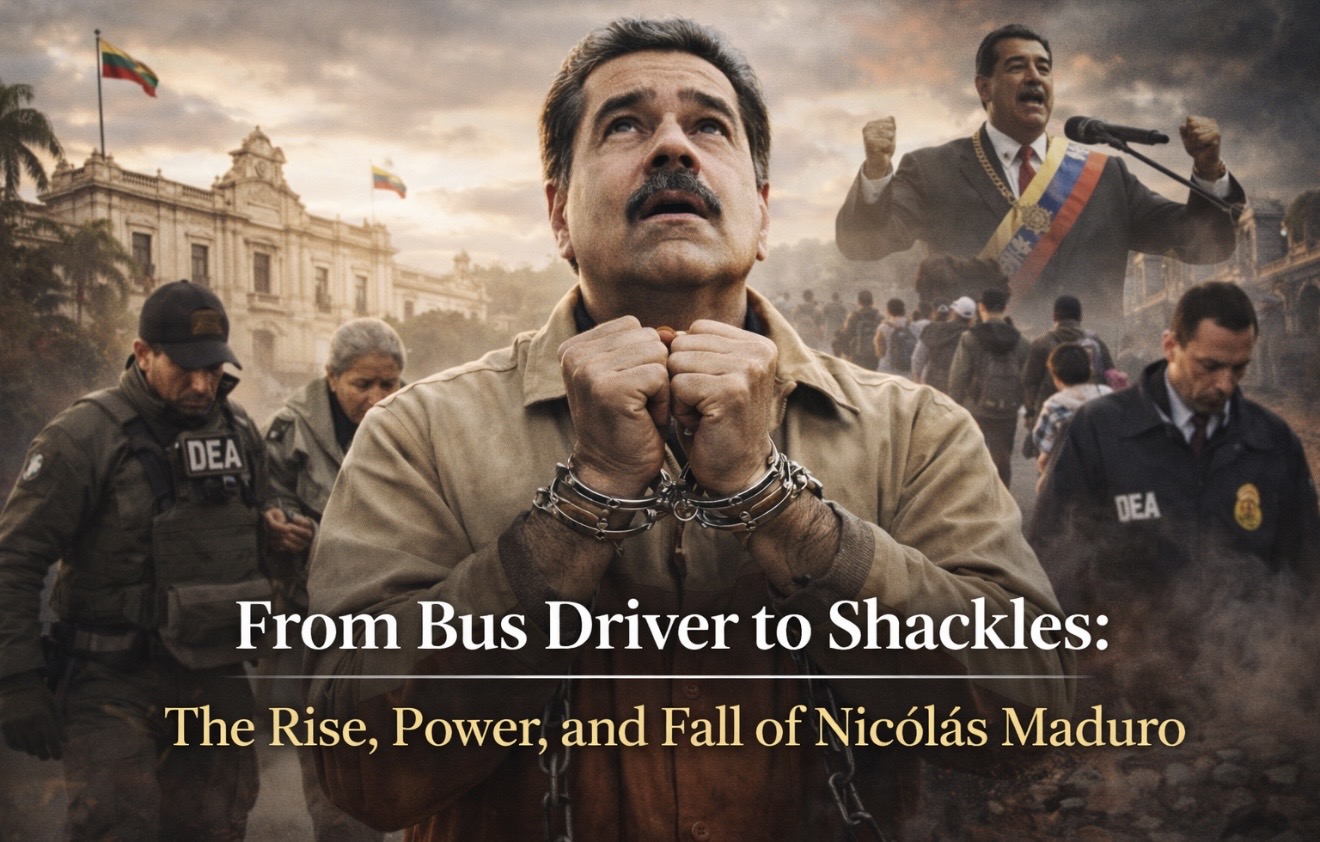
From Bus Driver to Shackles:
The Rise, Power, and Fall of Nicolás Maduro
By Raja Zahid Akhtar Khanzada
That day, like millions of others around the world, my eyes were fixed on a television screen. I was not sitting on a bench inside a New York courtroom, yet the entire scene unfolded vividly before me. Televisions, mobile phones, social media livestreams, and the breaking news tickers of global networks converged in a single moment. The thudding sound of a helicopter, a convoy descending into the cold air, and images that may well endure for years as a distilled symbol of Venezuelan politics all appeared at once, across multiple screens.
Venezuela’s president, Nicolás Maduro, walked in New York between U.S. district attorney officials, his feet bound in shackles and his hands cuffed. Beside him was his wife, Cilia Flores. Both wore blue and orange, the unmistakable colors of prison uniforms in the United States, though Maduro’s khaki trousers stood out beneath the layers of restraint. In videos circulating on social media, there was a moment that lingered longer than the rest. Maduro suddenly lifted his head and looked toward the sky, his eyes heavy with something like longing, as if he were speaking silently to God. I paused that frame again and again. It was not merely a glance. It felt like an entire lifetime compressed into a single second.
I found myself thinking of a man who, for years, had bent uniforms, judges, institutions, and the law itself to fit his narrative at home. Now he stood inside a uniform over which he had no control. Between blue and orange stood the man who once called himself the heir to Simón Bolívar, now reduced to a file number in the color-coded system of American justice. Perhaps that was why, when he briefly raised his eyes to the sky, the look was neither political nor defiant. It was not the gaze of power. It was the gaze of a man who may have realized, for the first time, that power can change its clothes, but systems always make sure you wear theirs in the end.
Outside the courthouse, supporters and opponents gathered in equal measure.
Inside, the proceedings were not broadcast live, but reporters present described the scene. To follow the Spanish interpretation, both Maduro and his wife wore headphones. A lawyer sat between them, clutching documents and offering whispered counsel. When Maduro was brought to the dock, another sound entered the courtroom’s silence. The sound of shackles. A sound clearer, more honest, than any chant of power. At that moment, Maduro turned toward journalists and those present and said he had been kidnapped.
At the start of the hearing, Judge Alvin Hellerstein asked for identification. Maduro replied in Spanish, calmly and deliberately:
“Sir, I am Nicolás Maduro. I am the president of the Bolivarian Republic of Venezuela, and I was abducted and brought here on January 3.”
As the session concluded, a man seated in the gallery suddenly shouted that Maduro would “pay for his crimes.” Maduro responded, again in Spanish, addressing the man directly:
“I am a president, and I am a prisoner of war.”
At that sentence, I looked away from the screen for a moment. In those few words, the entire story seemed to collapse into itself. From bus driver to president, and from president to prisoner. I found myself thinking that this was not merely the story of an arrest. It was the story of a long journey. From an ordinary man to the state, and from the state to the courtroom.
Nicolás Maduro’s life does not begin in a palace. He was born in a working-class neighborhood of Caracas. His father was a trade union activist. His mother, a resilient woman from a border region. Politics filled the home, but comfort did not. He went to school, joined student unions, but never completed formal education. Eventually, he became a bus driver. The Caracas Metro bus. Daily passengers. Daily exhaustion.
This was the phase in which Maduro saw the public up close. Driving a bus is not merely about transporting people from one stop to another. It is about passing through faces every day. Someone’s desperation. Someone’s urgency. Someone’s silence. During this time, he organized unions, raised his voice, learned how to speak, how to negotiate. The union taught him how to demand, how to persuade, and how to speak to power itself. This is where his political life began.
Then came Hugo Chávez. A revolution. A slogan. A dream. Maduro walked alongside that dream. He showed loyalty and persistence, and gradually moved forward. He reached the National Assembly, became its speaker, and later served as foreign minister. His closeness to Chávez was not merely ideological. It was built on trust. Chávez trusted him, appointed him vice president, and before his death told the nation that if he were no longer there, Maduro should be chosen.
Up to this point, Maduro’s story resembles a classic political ascent. A working-class man entering the system and rising to its summit. After assuming power, he made decisions that his supporters still cite as examples. It would be dishonest to claim that nothing positive occurred during his entire tenure. He strengthened ties with several countries in Latin America and Africa. He stood with Palestine, Cuba, and states that saw themselves as weak within the global order. He openly challenged American dominance, and to his supporters, he emerged as a defiant and self-respecting leader.
After Hugo Chávez’s death, when the state was visibly unstable, Maduro did not entirely dismantle social programs. Food distribution systems, subsidies, and state support for the poor continued in one form or another. Despite severe U.S. sanctions, Venezuela did not completely collapse. After 2019, Maduro quietly eased economic controls. Price caps were lifted, limited space was granted to private enterprise. Hyperinflation declined noticeably, and goods began to reappear in markets.
Yet despite these measures, popular support never stabilized. In 2013, under the shadow of Chávez’s legacy and public sympathy, Maduro’s approval hovered between 45 and 50 percent. After 2014, it fell sharply. According to multiple credible surveys, between 2018 and 2023 his popularity often fluctuated between 15 and 25 percent. Notably, the poorest segments of society, once the strongest base of Chavismo, were the first to drift away.
Maduro thus became a president who managed to hold the state together while the nation slowly slipped from his grasp. It is also true that for a time he prevented Venezuela from total disintegration. Oil revenues sustained the machinery of the state, the military remained aligned, and the structure of power endured. Many saw this as political skill.
But power carries another truth. When conditions deteriorate, good intentions are not enough. Oil prices fell. The economy came under pressure. Inflation surged. Shortages spread. This was Maduro’s defining test. He could have chosen reform. He could have chosen dialogue. Instead, he largely chose force. Protests were met with repression. As dissent grew, institutions mobilized. Courts, electoral bodies, and security forces gradually became instruments of preserving power.
This was the turn where Nicolás Maduro’s story began to change.
Allegations of human rights abuses surfaced. Reports of extrajudicial killings followed. Journalists were silenced. Millions were forced to leave their country. None of this happened overnight. It unfolded over years, quietly at first, and then with such intensity that the world could no longer look away.
I have seen those reports. I have seen those photographs. I have watched those videos. Accusations of extrajudicial killings, enforced disappearances, torture, pressure on journalists, and a silent exodus in which millions of Venezuelans were pushed toward borders they never imagined crossing. Throughout this period, Maduro dismissed every charge as a conspiracy. He named the United States as the enemy. He described the global system as imperialist. For a time, these explanations appeared to satisfy his supporters. But as the years passed, the tone of power hardened, and the shadow of the state grew longer. Every accusation became a plot. America, Europe, international institutions, all were cast as enemies in his narrative.
As I watched the scene unfold that day in a New York courtroom, one question kept returning to me. How does the arrest of a single man come to contain the story of an entire nation?
Venezuela, once home to nearly thirty million people, has now lost almost a quarter of its living soul. According to the United Nations, more than 7.9 million Venezuelans left their country during Maduro’s rule. This was not simply migration. It was collective retreat.
These were the people seen standing in long lines at borders. People who carried children on their shoulders and walked for days. People who did not carry identity cards, but memories. One in four Venezuelans now lives outside the country. The remaining three carry within them a weight of fear, hunger, and silence that no census can measure.
In the courtroom, people heard the sound of shackles. I heard it too. But at that moment, I could also hear the voices scattered across refugee camps in Colombia, Peru, and Brazil. Voices that have been asking the same question for years. If all of this was justified, then why were we forced to leave our home?
There were elements of truth in the official narrative. But when a state begins to label every question as hostility, the line between truth and falsehood begins to dissolve. History then takes a turn that every powerful leader believes to be impossible.
The arrest in January 2026. The courtroom in New York. And the same Maduro who once addressed global forums was now stating his identity before a judge. The same man who called himself the heir to a revolution was now walking in chains. He told the court he had been abducted. Perhaps he truly believes he is a victim. Perhaps power, when held for too long, distances a person so completely from reality that even one’s own end begins to look like a conspiracy.
As I watched, I kept thinking that Maduro is neither a complete hero nor a complete villain. He is a human being. A man who rose from the bottom to the top. A man who tried, at least at times, to become a source of hope for some. But also a man who, out of fear of losing power, made grave and damaging decisions. His life offers a lesson that history repeats often. Struggle can lift a person upward, but power exposes them.
Standing in a New York courtroom today, Maduro was no longer just a defendant to me. He had become a moving symbol of an entire era. An era filled with slogans, promises, and dreams, followed slowly by a fear that replaced those dreams. History may one day attempt to understand some of his decisions within their context. But there are decisions that time itself refuses to excuse.
Politics always manufactures new narratives. But within every human being exists a silent court that remembers everything.
I was watching all of this on a screen, yet the scene delivered its lesson clearly. Reaching power may be difficult. Remaining human while holding power is a far harsher test.
Maduro passed through that test unevenly. At times he stood firm. At times he stumbled. At times he may have lost himself entirely. Struggle can raise a person. Power, inevitably, unmasks them. And those who forget themselves in that unmasking eventually hear their entire story echoed back to them in the sound of shackles.
When the scene in the New York courtroom ended, I turned off the screen. But the sound did not stop. The sound of chains. Perhaps that sound is the true title of this column. And perhaps it is the final warning to every powerful man who believes history will never reach his door.