

At a high-level conference on Monday, France and Monaco formally recognized the State of Palestine. Before announcing the diplomatic move, French President Emmanuel Macron stated, “We must do everything within our power to preserve the very possibility of a two-state solution, Israel and Palestine living side by side in peace and security,” which was met with lengthy applause.
Macron outlined a framework for a “renewed Palestinian Authority,” under which France would open an embassy contingent on factors like reforms, a ceasefire, and the release of all remaining prisoners in Gaza. Following recent recognitions by Australia, Britain, Canada, Portugal, and Malta, Andorra, Belgium, Luxembourg, and San Marino were also expected to recognize a Palestinian state ahead of this week’s UN General Assembly.
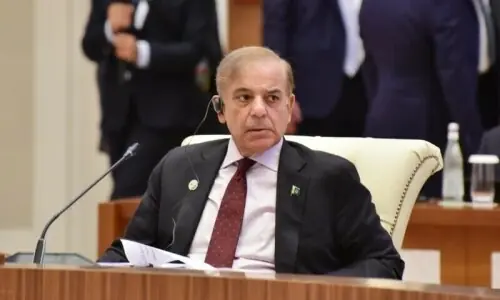
Foreign Minister Ishaq Dar, who represented Pakistan at the conference, was not among the speakers, a list that included heads of state and government from countries such as Turkiye, Australia, Brazil, and Canada. Prime Minister Shehbaz Sharif, who arrived in New York on Monday, did not attend the meeting. In a statement, the Foreign Office noted that Pakistan actively participated in the conference. On X, the foreign minister welcomed the announcements regarding the recognition of Palestine by several countries.
He recalled that Pakistan was among the first nations to recognize the State of Palestine after its declaration of independence in 1988 and urged all countries that have not yet done so to follow suit, in line with their commitment to international law. This call was echoed by Palestinian President Mahmoud Abbas, who addressed the conference via video link after being denied a visa by the United States. “We call on those who have not yet done so to follow suit. We call for your support so that Palestine becomes a full-fledged member of the United Nations,” he said, promising reforms and elections within a year of a ceasefire. The conference, which focused on the two-state solution, came as Western powers, breaking from decades of policy, have agreed to recognize the Palestinian state. The UK, responsible for the 1917 Balfour Declaration that led to the creation of the State of Israel, also opened the Palestine embassy in London on Monday.
Meeting with Trump
The White House and Pakistani diplomats announced on Monday that Prime Minister Shehbaz Sharif will represent Pakistan at a multilateral meeting with US President Donald Trump. While White House Spokesperson Karoline Leavitt did not specify the agenda, sources indicated that the Israeli war in Gaza would be the dominant topic. The meeting will include leaders from eight Muslim-majority countries: Pakistan, Turkiye, Qatar, Saudi Arabia, Indonesia, Egypt, the UAE, and Jordan.
Trump is expected to address the UN General Assembly before the multilateral meeting. According to Ms. Leavitt, the president will speak about how “globalist institutions have significantly decayed the world order” and will articulate his vision for the world. Leavitt also stated that Trump “disagrees with” the recent decisions by Britain, Canada, Australia, and France to recognize the state of Palestine. She noted that he believes this recognition is “a reward to Hamas” and is “just more talk and not enough action from some of our friends and allies.”
Flag-Raising Ceremony
Meanwhile, a day after the UK extended recognition to the State of Palestine, a flag-raising ceremony was held outside the Palestinian mission in London. The head of the mission, Husam Zomlot, hailed the “long overdue” recognition as the flag was raised. Holding up a plaque that read ‘Embassy of the State of Palestine,’ Mr. Zomlot said it would be installed soon, “pending some legal work, some bureaucratic work.” He called the recognition an “acknowledgement of a historic injustice” at a time of “unimaginable suffering” for the Palestinian people in Gaza. UK Foreign Secretary Yvette Cooper said the Palestinian Authority can now “set up an embassy and an ambassador in the UK.” Following the announcement, the UK foreign ministry also updated its travel advice page, replacing the reference to “Occupied Palestinian territories” with “Palestine.”
