

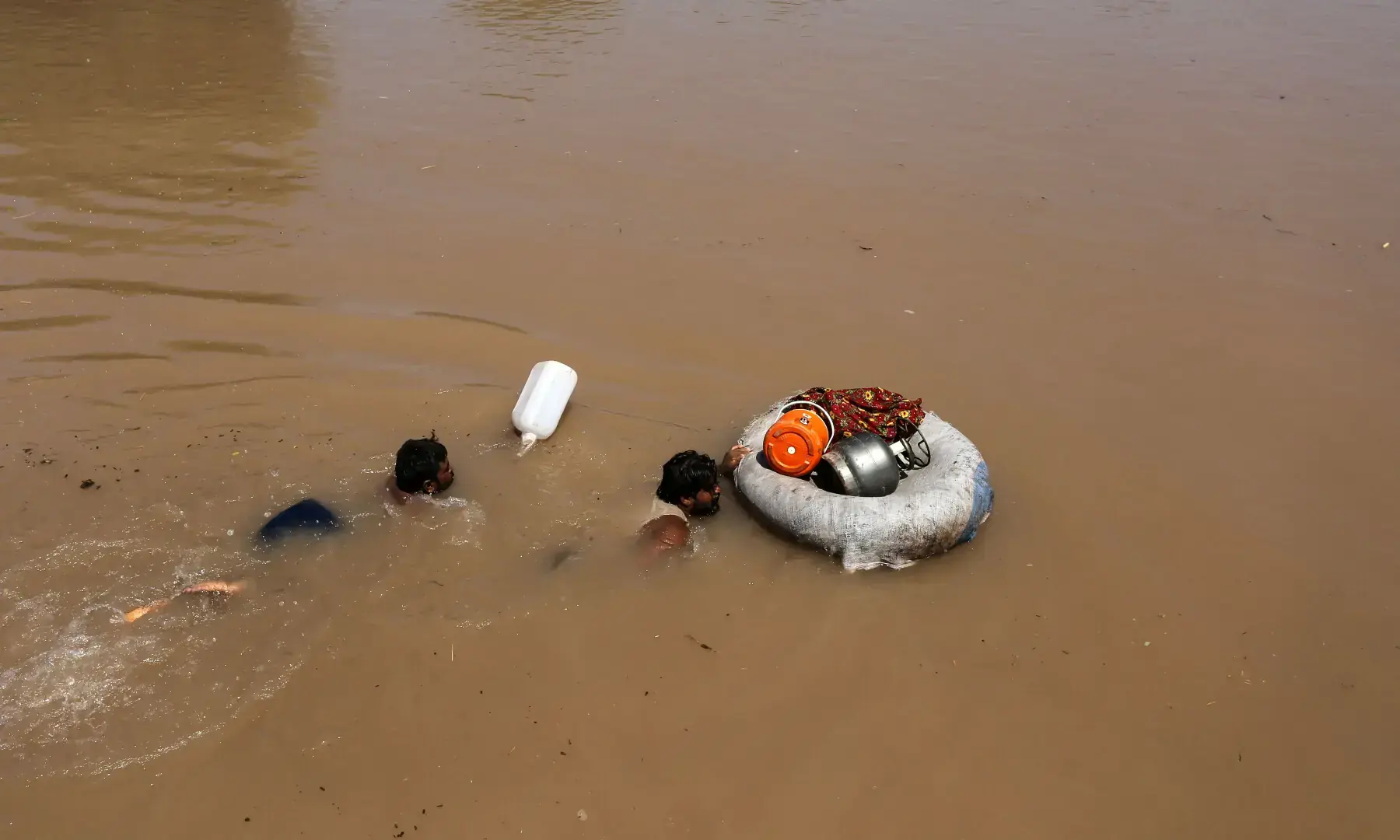
In some parts of southern Punjab, water levels have begun to recede significantly. The tehsils of Jalalpur Pirwala and Alipur in Multan have been declared safe after a major flood passed through Head Panjnad. Despite this, officials stated that evacuation and relief efforts are still underway in low-lying areas along the Chenab, Ravi, and Sutlej rivers.
A total of 12,427 people were evacuated from these areas in what officials called one of the largest rescue operations in recent history, involving a fleet of 1,517 boats. According to Punjab Rescue spokesperson Farooq Ahmed, the districts of Multan, Muzaffargarh, and Rahim Yar Khan were among the hardest hit, with 3,274, 2,392, and 414 people rescued, respectively.
Evacuation efforts also extended to other districts, including Lodhran, Bahawalpur, and Kasur. The Provincial Disaster Management Authority (PDMA) reported that an impressive 2.5 million people have been evacuated from Punjab so far, with the floods claiming 101 lives and necessitating the rescue of 2.19 million cattle.
Officials have confirmed a notable decrease in water levels in certain areas. The government declared Jalalpur Pirwala and Alipur tehsils safe after a large flood wave passed through Head Panjnad, where the water flow dropped dramatically from 684,000 cusecs on Friday night to 492,695 cusecs by Saturday evening, a decrease of nearly 200,000 cusecs in 24 hours.
The PDMA stated that flows at most major headworks on all three rivers were “steady.” Despite the improving situation, the humanitarian crisis remains severe. The entire union council of Lati Mari in Alipur tehsil, with a population of 40,000, was completely submerged.
A Lati Mari resident, Syed Kausar Shah, told Dawn that about 15,000 people from his area, Basti Azeem Shah, evacuated on their own as the water began to rise. He reported that all their homes and crops were destroyed and that two people who could not evacuate in time drowned.
He mentioned that a private boat was hired to help with the evacuation. “Most of them are staying with relatives in Alipur city, some are sitting on the dyke under the open sky, while others have moved to government relief camps,” he added. The flood victims also suffered significant losses of cattle, as most could not evacuate their livestock. He said that six to seven feet of water is still flowing in their union council, preventing them from retrieving their belongings or assessing the safety of their homes.
Multan DC Waseem Hamid Sindhu said that 100,000 people were evacuated from Jalalpur Pirwala over the past three days. He stated that efforts are being made to fill breaches in Shujabad and Jalalpur Pirwala, and helicopters and drones are being used to transport medicine and dry food to remote areas.
He confirmed that Jalalpur city was made safe and that the major flood wave from the Chenab and Sutlej rivers was crossing Head Panjnad. He added that relief and rehabilitation efforts for the flood-affected people have started, and food is being distributed by boat in the city’s rural areas.
Speaking at a press conference in Bahawalpur, PDMA Director General Irfan Ali Kathia said that Panjnad Headworks is facing an extremely high flood, with the water flow reaching 575,000 cusecs. He noted that the water flow at Panjnad had receded by 80,000 cusecs in a few hours, and a maximum of 700,000 cusecs had crossed three days prior.
He said that the Sutlej River had swelled to 385,000 cusecs this season, and all three rivers in the province experienced high-level flooding simultaneously. He stated that there was no threat to the cities of Jalalpur Pirwala and Alipur and that water would also recede in Bahawalpur in the next 24 hours. He added that a “historic” evacuation operation was conducted in Jalalpur Pirwala and that a forced evacuation would have been conducted in the district of Multan.
The DG also said that 4,447 villages in 28 districts were affected by floodwaters, and 2.5 million people were evacuated from Punjab. He reported that 101 people lost their lives in the floods and 2.19 million cattle were also rescued and moved to safe places.
According to data from the Flood Forecasting Division at 9 PM on Saturday, the water flow across major rivers was largely normal and steady.
On the Chenab River, flows are steady at all key locations, including Marala Headworks (62,081 cusecs), Khanki Headworks (65,049 cusecs), Qadirabad Headworks (64,588 cusecs), and Trimmu Headworks (100,645 cusecs). The flow at Panjnad Headworks was at 492,695 cusecs but was falling. The water level at Rivaz Bridge was 517.20 feet, which was steady and below its maximum level of 525 feet.
On the Ravi River, water outflow was normal at Jassar (13,797 cusecs), Shahdara (14,906 cusecs), and Balloki Headworks (27,970 cusecs), but it was in a low flood state at Sidhnai Headworks at 40,809 cusecs.
On the Sutlej River, the water flow was in a medium flood state at Ganda Singh Wala Headworks (95,000 cusecs) and Islam Headworks (82,155 cusecs), while it was in a low flood state at Sulemanki Headworks (69,019 cusecs).
