

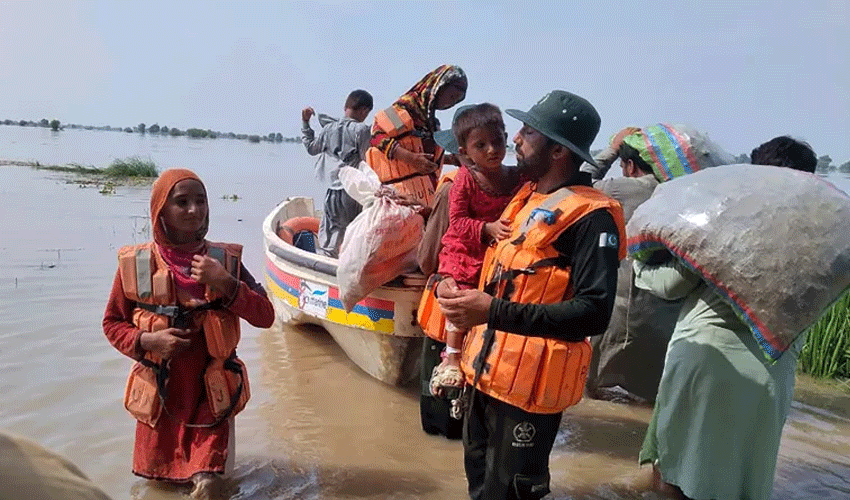
The flood situation across Punjab intensified on Sunday as rising water levels in the Sutlej and Chenab rivers submerged hundreds of villages. This led to large-scale evacuations and the destruction of standing crops on thousands of acres.
According to the Ministry of Water Resources, India has released more water into the Sutlej, a move that Pakistan considers a violation of the Indus Water Treaty. The ministry stated that while New Delhi had informed Islamabad via its High Commission, emergency alerts were still necessary as very high flood levels were recorded near Harike and Ferozepur. Authorities warned of potential devastation downstream and urged relevant departments to take precautionary measures.
Flooding Devastates Jhang and Alipur
In Jhang district, the situation turned critical after floodwaters from the Chenab River inundated more than 300 villages. Residents of Balo Shahabal and nearby areas complained that no rescue teams had reached them yet, even as water began to seep into their homes and weaken mud walls. At Trimmu Headworks, the flow of water surged past 543,000 cusecs, heightening fears of further damage. In Alipur, a breach in the Chandrabhan protective dam flooded the villages of Azmatpur and Malanwali. This caused the loss of cotton, sesame, and onion crops on thousands of acres, and submerged hundreds of homes. Displaced families were seen moving to higher ground in the rain with their belongings, seemingly without official assistance.
Multan Braces for Further Inflows
Multan also reported a worsening flood emergency, with over 138 villages impacted and more than 500,000 residents evacuated. Local authorities stated that another 350,000 cusecs of water had entered the Chenab from Head Trimmu, submerging hundreds of homes in Basti Taliwala and cutting off land routes. Pakistan Peoples Party Chairman Bilawal Bhutto Zardari visited the affected areas to meet with families.
According to the Water and Power Development Authority (WAPDA), the country’s total water storage has now exceeded 12.4 million acre-feet (MAF) as inflows into major dams and rivers continue to rise. WAPDA’s daily report noted that total water inflows were 34,400 cusecs, while outflows reached 224,400 cusecs, adding pressure on downstream river systems. At Tarbela Dam, the water level has reached 1,550 feet with over 5.7 MAF of live storage. Inflows at Tarbela were recorded at 158,000 cusecs, with outflows at 154,000 cusecs. Meanwhile, Mangla Dam holds 6.4 MAF at a water level of 1,231 feet, with inflows at 38,000 cusecs and outflows at 9,000 cusecs.
River Conditions Across the Country
The Kabul River has risen above 27 feet, raising concerns of further swelling downstream. At Kala Bagh, inflows were 199,000 cusecs and outflows were 192,000 cusecs. Chashma Barrage recorded inflows of 235,000 cusecs and outflows of 219,000 cusecs. At Tunsa Barrage, inflows reached 228,000 cusecs, while outflows were 217,000 cusecs. Guddu Barrage reported heavy inflows of 392,000 cusecs with an outflow of 362,000 cusecs. At Sukkur Barrage, inflows were 324,000 cusecs, while outflows dropped to 280,000 cusecs. Kotri Barrage saw inflows of 244,000 cusecs and outflows of 231,000 cusecs.
PDMA Issues High Alert
DG Punjab Disaster Management Authority (PDMA) Irfan Ali Kathia confirmed that the “first rail” of Chenab floodwater had passed Head Muhammad Wala and was moving toward Panjnad, with inflows expected to reach 500,000 cusecs in the next few hours. He warned that “floods will continue to impact Multan for the next 72 hours, while Sindh may receive 700,000 to 800,000 cusecs from Chenab and Ravi combined.”
Kathia added that 25 districts in Punjab have already been affected, with 60,000 to 70,000 people now in relief camps. He described the ongoing rescue operation as the “largest in Punjab’s history” but noted that tragic events, including the death of a woman and four children in Jalalpur Pirwala, underscore the severity of the crisis.
Rainfall Adds to Misery
Heavy rainfall has compounded the disaster, with Mangla recording 72mm in the last 24 hours. While water levels have started to recede at some points, including Ravi and Ganda Singh Wala, authorities cautioned that river inflows remain unpredictable. Punjab Chief Minister Maryam Nawaz visited Gujrat to oversee relief operations, where officials expect floodwater to clear within 22 hours.
