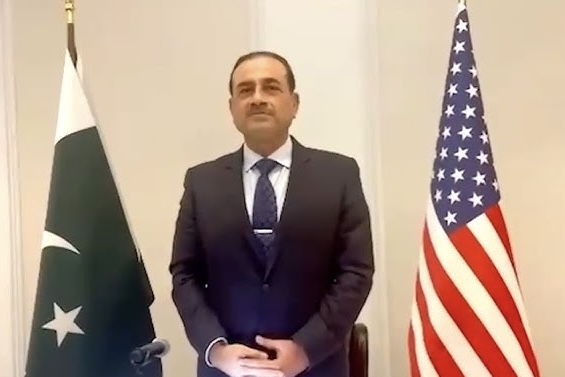
Field Marshal Asim Munir — As I Saw Him with New Eyes
By Raja Zahid Akhtar Khanzada
Living amidst the vast expanse of America, my heart often beats faster at the mention of my homeland a place that is no longer just a street or a city, but a symbol of spirit and belonging. And when the conversation turns to the commander of that homeland, his name doesn’t simply echo it rumbles like distant thunder. A thunder that carries some truth, some speculation, and many stories stories more heard than understood.
That is why, when the name of Pakistan’s Field Marshal Syed Asim Munir reverberates here in the U.S., it no longer remains just the name of a man. It becomes an image a silhouette often sketched in negative commentary, political debate, and half-formed truths.
There is a certain group here that often brands him a symbol of authoritarianism, others call him a threat to democracy, and some paint him as the crownless king of the establishment. But then came a day an evening and a meeting, that reshaped every question within me in the light of a new understanding.
On the evening of June 16, 2025, in Washington D.C., I had the chance to meet him face-to-face, to listen not just with ears, but with heart. And in that moment, all the layers of perception wrapped for years in political dust began to lift, one by one. What emerged was not just a general. It was a man, a mind, and a soul.
When a young attendee at the event raised a difficult question, voices in the crowd began to rise, a ripple of restlessness swept across the hall.
And then as if to steady the air I, and everyone else, heard that general calmly raise his hand and say:
“Let him speak.”
It was a short sentence, yes. But within it was the essence of leadership not the kind born from rank or ceremony, but the kind that arises from character.
The kind that sees disagreement not as insult, but as a right even as a gift.
That was the moment I realized:
This general, so often seen as a cold shadow,
was in fact a tree, beneath whose shade, questions could bloom and answers could be offered in peace.
He was not a broken branch that issues commands and moves on he was a strong, rooted tree that could endure challenge, listen to dissent,
and recognize a question not as rebellion, but as an invitation to wisdom.
The clarity with which he spoke,
the composure with which he responded to the community’s questions every word reflected not only his military training, but also the grace of a home where respect is taught, disagreement is endured,
and logic is valued far more than personal offense. In his voice, I didn’t just hear a general. I heard the echo of a house where elders speak gently,
where discipline is tied to humility,
and where leadership isn’t wielded,
but practiced with dignity.
His tone, his choice of words, the sincerity tucked between his sentences all of it bore silent witness that he was not merely a representative in uniform, but a soul raised at the intersection of knowledge, character, and humility. That moment, when the questioner hesitated and the crowd was on the verge of uproar, it was he the Commander of the Nation who, with the gentleness of his voice, restored balance to the gathering.
Such conduct does not stem from position alone. It is born of heritage
from the courtyard of home, from the prayers of parents, and from a kind of upbringing that teaches one to lower their gaze before raising their voice.
And it was that very upbringing that inner grace which compelled me to reconsider, to shift my perspective from old assumptions to a new and present truth.
Perhaps it is this very clarity that is not born of merely listening but from truly seeing.
This soldier, born of the soil of Rawalpindi, the son of a mosque imam, a heart inscribed with the Qur’an first made his mark by winning the Sword of Honour in Mangla’s military grounds. He trained in silence,
stood firm on the battlefield, and led Pakistan’s two most sensitive intelligence agencies MI and ISI
skillfully countering both internal conspiracies and external threats.
And then came the moment when Field Marshal Asim Munir invoked the name of Bunyān al-Marsūs, the time when the enemy rattled sabers, and General Munir responded not with noise, but with strategy.
This was a war not fought merely on borders, but across hearts, narratives, and ideologies. In his address, he recalled: when India said, “We are ready for dialogue,” Pakistan’s answer was firm: “We will do what duty demands… and then see if there is anything left to talk about.”
Ten Indian fighter jets were locked on Pakistani radar, but only those were brought down that had, in fact, attacked. That is the gold standard of moral superiority.
One that silences even the enemy. One that doesn’t earn medals, but forges the dignity of nations.
I will never forget that evening at the Four Seasons Hotel. As Field Marshal Munir spoke, chants rose from the crowd:
“Tera Veer, Mera Veer — Asim Munir, Asim Munir!”
And amidst that roar stood passionate Pakistanis like Fasih Rizvi from Dallas,
whom the Field Marshal recognized from afar, called up to the stage,
and held his hand for a long while as though a soldier had embraced the spirit of his people.
Afterward, General Asim Munir visited each table, shook hands with everyone, spoke with calm dignity never treating anyone as lesser, never overlooking a single soul.
The next day brought another unforgettable moment, when the President of a global superpower, Donald Trump, in a press conference,
called Pakistan’s Field Marshal “an extraordinary leader.”
That praise was no diplomatic courtesy, it was salt in a wound India had hoped the world would never notice.
When Trump hosted him at an official White House luncheon, and multiple political leaders called the meeting “a meaningful breakthrough in bilateral ties,” the message was loud and clear:
the world has started to view Pakistan through the mirror of its general.
I still remember one line from General Asim’s speech a line that struck me with hope and conviction. He said:
“In 2047, Pakistan will be part of the G10.”
This was not a slogan. It was the declaration of a vision, a dream that rises from the scent of the soil and seeks to perfume the world’s economy.
His meeting with the Pakistani diaspora on June 16 wasn’t just a speech. It was a commitment, a promise, a direction. And all of it came not just from a general’s tongue but from the voice of a man who had once reached for the branch of peace before he ever held the sword of war.
Yet who refused to accept any peace devoid of dignity.
Perhaps that was the moment when I realized. Syed Asim Munir is not just a man in uniform. He is dignity, standing tall.
He is like a book!
one that many judged by its cover,
some heard of but never truly read,
others criticized without even opening.
But I am among those who opened the book for myself, turned its pages,
and inhaled the fragrance of its words.
And now I can say with certainty, the general I heard in Washington was not only one who commands, he was one who listens, who understands,
and yes… he is truly a son of the nation.