

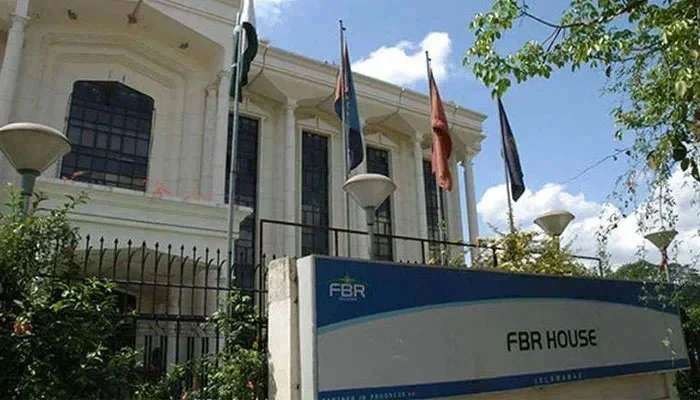
The Federal Board of Revenue (FBR) has provided assurances that adequate safeguards are in place to prevent the misuse of arrest powers outlined in the proposed Finance Bill 2025-26, as reported by The News on Sunday.
In a statement, the FBR highlighted recent news coverage in digital and print media, suggesting that certain amendments within the bill, particularly those concerning legal provisions for the arrest of individuals involved in tax fraud, have been misunderstood by the general public.
These provisions are already established under Section 37A of the Sales Tax Act, 1990, which includes a detailed procedure to be followed post-arrest. This procedure mandates immediate intimation to a special judge and the production of the arrested person before the judge within 24 hours.
However, the proposed amendments now introduce a restriction on an officer’s power to arrest, requiring a prior inquiry with the approval of the Commissioner of Inland Revenue (CIR). Only based on the findings of this inquiry will the CIR authorize an investigation, which would then grant the investigating officer powers akin to an officer in charge of a police station under the Code of Criminal Procedure, 1898 (Act V of 1898).
An arrest can only be made with the CIR’s prior approval if the investigating officer has reasonable grounds to believe that tax fraud has been committed.
The new legal provision further stipulates that if an arrest is found to be mala fide (in bad faith), the matter will be referred to the Chief Commissioner for a fact-finding inquiry. This indicates a move towards greater transparency compared to the earlier provision, where an Assistant CIR could make an arrest. The new provisions mandate a prior inquiry, investigation, and final permission from the CIR.
Furthermore, these changes are deemed necessary to reassure compliant taxpayers that tax evaders and those involved in tax fraud will be dealt with decisively by the state. FBR Chairman Rashid Mahmood Langrial has expressed willingness to discuss the recent changes in tax laws and introduce further modifications where needed. For instance, the provisions related to arrest could be revised to mandate permission from multiple senior officers before any arrest is made.
To ensure these powers are not misused against compliant taxpayers and the business community, Prime Minister Shehbaz Sharif has established a high-powered committee. This committee, chaired by the finance minister, will evaluate the proposed amendments and recommend adequate safeguards to prevent potential abuses of power.
The committee’s other members will include the Ministers of Law and Economic Affairs Division, the Minister of State for Finance, the SAPM on Industries, and the FBR Chief.
The committee will also explore various options to ensure that legitimate economic activities are not stifled and will propose additional protective measures against the unlawful use of authority. It is expected to submit its recommendations to the prime minister within three days.
The FBR remains committed to safeguarding the legal rights of compliant taxpayers and increasing tax collection and state revenues by discouraging non-compliant taxpayers and recognizing those who fulfill their obligations to the state.
It is important to note that PM Shehbaz has outlined six prerequisite conditions for incorporating the arrests of CEOs, CFOs, and board of directors:
- If a person involved in tax fraud attempts to escape.
- Attempts to tamper with evidence.
- Fails to appear after three summons notices.
- A certain defined tax fraud limit.
- A tax fraud amount of Rs50 million for the arrest of executives.
- Approval by a special board of the FBR, along with a representative from a private member, likely from the Chamber of Commerce, for arrests.
Moreover, the Senate Standing Committee on Finance has requested the FBR to define a threshold and establish slabs for allowing arrests in tax fraud cases and imprisonment of up to ten years under the proposed Finance Bill 2025-26. The tax collection body has suggested a maximum limit of Rs10 million for allowing an arrest.
