

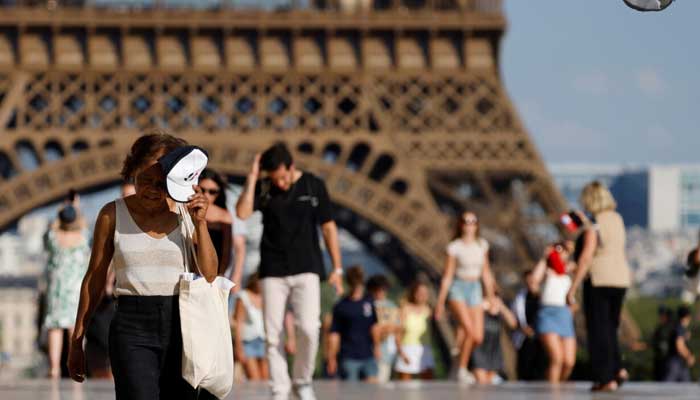
On Tuesday, Paris was placed on red alert for high temperatures, leading to the closure of the Eiffel Tower’s summit, a ban on polluting traffic, and the implementation of speed restrictions as a scorching heatwave gripped Europe.
Mediterranean countries, stretching from the Iberian Peninsula through France and Italy to the Balkans and Greece, have been enduring a severe heatwave for several days. This has prompted widespread health warnings and alerts about an increased risk of wildfires. Scientists affirm that human-induced climate change is intensifying such heatwave events, making them more frequent and geographically widespread.
According to the Meteo France weather agency, temperatures in France were expected to peak on Tuesday, with the highest extreme heat warning issued for 16 departments across the country. An additional 68 departments were under the second-highest alert level. Meteo France forecasted very high minimum temperatures ranging from 20-24 degrees Celsius “or slightly higher in some localized areas, and maximums reaching 36 to 40°C with some peaks at 41°C.”
Operators of the Eiffel Tower closed the summit of the 330-meter (1,083-feet) landmark at 1100 GMT on Monday and confirmed it would remain closed on Tuesday and Wednesday “due to the current heatwave.” While access to the first and second floors remained open, operators urged visitors to exercise caution. “Remember to protect yourself from the sun and stay hydrated. Water fountains are available in the walkways leading to the esplanade,” they advised.
Across the Ile-de-France region, which includes Paris, police announced that all but the least polluting vehicles would be banned from roads from 0330 GMT to 2200 GMT due to high ozone pollution levels. Speed limits of 20 kilometers (12.5 miles) per hour would also be enforced in certain areas. Nationally, the government anticipated that nearly 1,350 schools would be partially or completely shut—almost double the number from Monday—with teachers complaining that overheated and unventilated classrooms were causing students to become unwell. Warnings were specifically issued for young children, older individuals, and those with chronic illnesses.
Akshay Deoras, a research scientist at the National Centre for Atmospheric Science and Department of Meteorology at the University of Reading, west of London, emphasized, “Heatwaves are deadly. We need to treat extreme heat with the same seriousness we give to dangerous storms.”
Unusual Weather Phenomena and Fire Risks
Portugal is expected to experience some respite on Tuesday after two days on red alert in several regions, including Lisbon. Warnings will be downgraded to orange alert in all but eight inland areas. However, temperatures are still projected to reach 40°C in the central city of Castel Branco, Beja, and Evora in the south, and 34°C in the capital. The national meteorological agency IPMA reported that beachgoers in northern and central Portugal would have witnessed a rare “roll cloud” moving towards the coast on Monday. Images shared on social media depicted a massive horizontal cloud approaching the shore from the horizon, accompanied by a violent gust of wind upon reaching land. “The most frightening thing was the wind and everything becoming dark,” one swimmer told online media outlet ZAP. “It was very strange. We all started packing up our things and running. It looked like a tsunami.”
Similar temperatures ranging from the high 30s to mid-40s are forecast for Spain after soaring to 46°C in the south—a new record for June, according to the national weather agency. Red alerts have been issued for 18 Italian cities in the coming days, including Rome, Milan, Verona, Perugia, and Palermo, as well as across the Adriatic on the Croatian coast and Montenegro.
Italy also experienced another type of extreme weather event on Monday when a flash flood in the northern region of Piedmont, caused by heavy rains, claimed the life of a 70-year-old man. Alberto Cirio, the president of the region, commented on social media, “We are increasingly faced with emergency situations due to weather events that we used to call exceptional but are now more and more frequent.”
The Mediterranean Sea itself recorded a new June high of 26.01°C on Sunday, according to French weather service scientist Thibault Guinaldo, citing data from EU monitor Copernicus. The risk of forest fires remains elevated in several Portuguese regions. On Monday night, approximately 250 firefighters were battling a blaze in the southern Aljustrel area. In Turkey, rescuers evacuated over 50,000 people threatened by a series of wildfires, primarily from the western province of Izmir, where winds of 120 kilometers (75 miles) per hour fanned the blazes. Greece has also been actively combating wildfires.
