

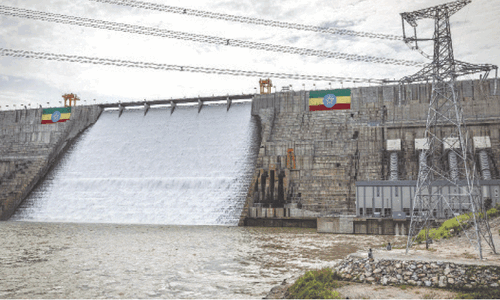
Ethiopia has inaugurated the Grand Ethiopian Renaissance Dam (GERD), a massive project on the Blue Nile that has been a source of national unity but also a major point of contention with downstream nations, particularly Egypt. At 170 meters (550 feet) high and almost two kilometers long, the dam is designed to generate 5,150 megawatts of electricity, more than doubling Ethiopia’s current capacity and making it Africa’s largest dam by power capacity.
Prime Minister Abiy Ahmed, who has made the project a cornerstone of his rule, praised the GERD as a “great achievement” for “all black people.” He said the dam is a shining example of what the region can accomplish. The inauguration ceremony was attended by regional leaders, including the presidents of Kenya and Somalia.
Egypt’s Protest and Concerns
Egypt, which relies on the Nile for 97% of its water, views the GERD as an “existential threat.” In a letter to the UN Security Council on Tuesday, Egypt’s foreign ministry described the inauguration as a “unilateral measure that violates international law” and vowed to defend “the existential interests of its people.” The letter accused Ethiopia of trying to create a “false cover of acceptance and legitimacy” for the dam.
In his speech, Prime Minister Abiy insisted that the dam would not harm downstream countries. However, Egyptian officials and experts remain concerned, with one former member of Egypt’s GERD impact assessment team, Mohamed Mohey el-Deen, stating that a major drop in water supply would threaten Egypt’s internal stability. He said the stakes are “economic, political and deeply social.”
Dam’s Purpose and Regional Impact
The Blue Nile provides up to 85% of the water that forms the River Nile. The Italian firm Webuild, the dam’s main contractor, stated that the project is for hydroelectric purposes, which release water to produce energy rather than consuming it for irrigation. They claim there will be no change in the river’s flow. However, mediation efforts over the past decade by the United States, World Bank, Russia, the UAE, and the African Union have all failed to reach an agreement.
For Ethiopia, the dam is seen as a way to boost industrial production, promote electric vehicles, and provide electricity to neighboring countries. According to the World Bank, about 45% of Ethiopia’s 130 million people lack access to electricity. The dam is also seen as a unifying symbol in a country facing internal conflicts, with some analysts noting that the government may be using it to distract from domestic political fragility.
