

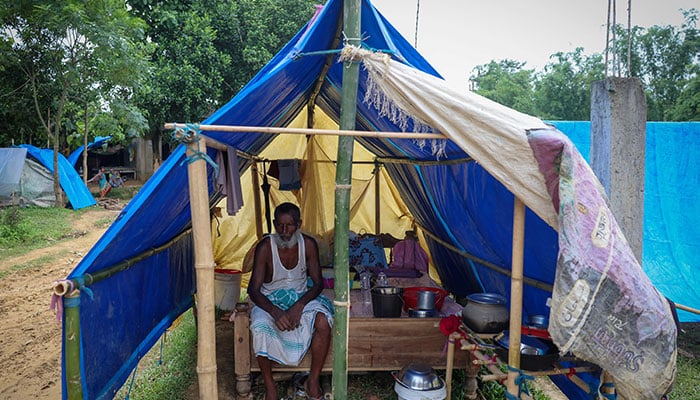
In a corner of northeastern India near Bangladesh, hundreds of Muslim men, women, and babies are seeking refuge under blue tarpaulins after being evicted from their homes. This marks the latest phase of a crackdown in Assam ahead of state elections.
They are among thousands of families whose residences have been demolished by authorities in recent weeks, an action described as the most intense in decades. Authorities accuse them of illegally occupying government land.
These demolitions in Assam, a state where Prime Minister Narendra Modi’s Hindu nationalist Bharatiya Janata Party (BJP) will seek re-election early next year, coincide with a national clampdown on Bengali-speaking Muslims. These individuals are being labeled “illegal infiltrators” from Bangladesh, a narrative that has intensified since the August 2024 ouster of a pro-India premier in Dhaka.
“The government repeatedly harasses us,” said Aran Ali, 53, outside a bare patch of earth in Assam’s Goalpara district, which has become a makeshift home for his family of three.
“We are accused of being encroachers and foreigners,” added Ali, who was born in Assam, as the scorching July sun beat down on their settlement.
Assam shares 262 km of India’s 4097 km-long border with Bangladesh. The state has a long history of anti-immigrant sentiment, driven by fears that Bengali migrants, both Hindus and Muslims, from the neighboring country could overwhelm local culture and the economy.
Security officials stand guard at a checkpoint near a demolition site in Goalpara district in the northeastern state of Assam, India, July 18, 2025. — Reuters
The current crackdown, carried out under the BJP government, has exclusively targeted Muslims, leading to protests where a teenager was killed days ago.
Assam’s Chief Minister Himanta Biswa Sarma, a prominent BJP leader often accused of inciting religious discord for populist gains ahead of nationwide polls, asserts that “Muslim infiltrators from Bangladesh” pose a threat to India’s identity.
“We are fearlessly resisting the ongoing, unchecked Muslim infiltration from across the border, which has already caused an alarming demographic shift,” he recently posted on X (formerly Twitter).
“In several districts, Hindus are now on the verge of becoming a minority in their own land.”
Last week, Sarma told reporters that migrant Muslims constituted 30% of Assam’s 31 million population as per the 2011 census.
“In a few years from now, Assam’s minority population will be close to 50%,” he projected.
Sarma did not respond to a Reuters request for comment.
Targets for Right-Wing Groups and Demographic Context:
The BJP has consistently promoted the idea of India, with its Hindu majority, as the natural homeland for all Hindus and has enacted policies seen as targeting the country’s large Muslim population. In 2019, the government amended India’s citizenship law, effectively fast-tracking naturalization for undocumented non-Muslim migrants from neighboring countries while excluding Muslims.
Since taking office in May 2021, Chief Minister Sarma’s government has evicted approximately 50,000 people, predominantly Bengali Muslims, from 160 square kilometers of land, with further evictions planned. In the past month alone, state data indicates that around 3,400 Bengali Muslim homes have been demolished in five eviction drives across Assam. In comparison, the previous government evicted some 4,700 families over five years until early 2021.
According to the 2011 Census, the religious breakdown of Assam’s population of 31,205,576 was approximately:
- Hindus: 61.47% (19,180,759 people)
- Muslims: 34.22% (10,679,345 people)
- Christians: 3.74% (1,165,867 people)
- Other groups constitute smaller percentages.
Security officials stand guard at a demolition site in Goalpara district in the northeastern state of Assam, India, July 18, 2025. — Reuters
“Bengali-speaking Muslims, regardless of their legal status, have become vulnerable targets for right-wing groups in India,” stated Praveen Donthi, senior analyst at International Crisis Group.
Indian opposition leaders have accused Sarma of utilizing these evictions and expulsions to polarize voters ahead of elections.
“These measures are politically beneficial and profitable for the BJP,” asserted Akhil Gogoi, an opposition lawmaker.
The main opposition Congress party, which suffered a significant defeat in the 2016 Assam election allowing the BJP to form its first government in the state, has pledged to rebuild the demolished houses and imprison those responsible for their destruction if returned to power.
Heightened Sentiments Against Bengali-Speaking Muslims:
The increase in evictions follows a deadly attack in April on tourists in Indian Illegally Occupied Jammu and Kashmir (IIOJK), which was attributed to “terrorists” from Pakistan—an accusation vehemently denied by Islamabad. Since then, BJP-ruled states have rounded up thousands of Bengali Muslims, branding them as suspected “illegal immigrants” and potential security risks.
Analysts suggest that worsening relations between New Delhi and Dhaka, following the ouster of Bangladesh’s Prime Minister Sheikh Hasina, have intensified anti-Bengali-speaking Muslim sentiments, providing the BJP with a political tool for garnering votes. Bengali is the primary language of Muslim-majority Bangladesh and is also widely spoken in parts of India.
States, including Assam, have also “pushed back” hundreds of Bengali Muslims into Bangladesh. Reuters has reported that some were brought back due to pending court appeals challenging their non-Indian status.
Debris is seen after a demolition drive by authorities in Goalpara district in the northeastern state of Assam, India, July 18, 2025. — Reuters
Assam officials claim that approximately 30,000 people have been declared foreigners by tribunals in the state. Such individuals are typically long-term residents with families and land. Activists argue that many are often erroneously classified as foreigners and lack the financial means to challenge tribunal judgments.
In 2016, New Delhi estimated that around 20 million illegal Bangladeshi migrants were residing in India.
“The Indian government is putting thousands of vulnerable people at risk in apparent pursuit of unauthorized immigrants, but their actions reflect broader discriminatory policies against Muslims,” commented Elaine Pearson, Asia director at Human Rights Watch.
India’s foreign ministry stated in May that the country has a list of 2,369 individuals to be deported to Bangladesh and urged Bangladesh to expedite the verification process. Bangladesh’s foreign ministry did not respond to a request for comment.
Since Hasina’s removal and an increase in attacks on Hindus in Bangladesh, CM Sarma has frequently publicized foiled infiltration attempts, with images of those apprehended widely shared on social media.
“The ethno-nationalism that had long animated Assam’s politics seamlessly merged with the religious nationalism of the BJP,” Donthi observed. “The focus then shifted from Bengali-speaking outsiders to Bengali-speaking Muslims.”
