

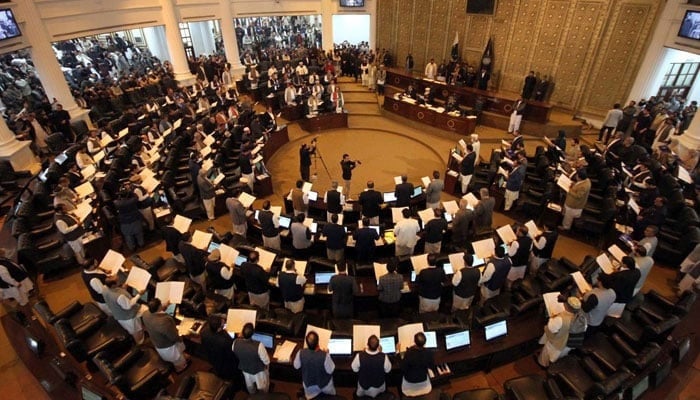
On Monday, the Election Commission of Pakistan (ECP) reserved its decision on petitions filed by Pakistan Muslim League-Nawaz (PML-N), Jamiat Ulema-e-Islam (JUI-F), and other parties concerning the allocation of reserved seats in the Khyber Pakhtunkhwa (KP) Assembly. A four-member ECP bench, led by Chief Election Commissioner Sikandar Sultan Raja, reserved the verdict after hearing arguments from all involved parties.
During the hearing, lawyers representing PML-N, JUI-F, and other political entities appeared before the election body. This development follows the Peshawar High Court’s (PHC) decision on July 8 to nullify the ECP’s previous notification regarding the distribution of reserved seats for women and minorities in the KP Assembly. The court’s two-page judgment was issued in response to a petition filed by the PML-N challenging the allocation.
The PHC had instructed the ECP to reallocate the seats within 10 days after hearing all relevant parties. The court also put a halt on the oath-taking of lawmakers for these reserved seats until the ECP’s final decision.
Speaking to the media outside the ECP office in Islamabad, JUI-F leader and lawyer Kamran Murtaza stated that all political parties presented their arguments to the commission during the day’s hearing. He mentioned that the PML-N had demanded a larger share of reserved seats, particularly following the inclusion of independent candidate Tariq Awan into their ranks.
Murtaza clarified the seat distribution formula, explaining, “If independent candidates join a party after the legally defined period, the number of reserved seats allocated to that party would not increase.”
In Khyber Pakhtunkhwa, the opposition alliance is nearing a simple majority, now just 20 seats away from shifting the balance of power in the provincial assembly after the reserved seats verdict. The Pakistan Tehreek-e-Insaf (PTI)-led government currently holds 92 seats, while the opposition’s numbers have risen to 53.
The KP Assembly has a total strength of 145 members, but currently, there are 115 elected members. Of the remaining 30 seats, 26 are reserved for women and four for minorities.
Earlier, on July 2, the ECP had reinstated 74 out of 77 reserved seats, which included 19 National Assembly members, 27 Punjab Assembly members, 25 KP Assembly members, and 3 Sindh Assembly members. This action followed the Supreme Court’s June 27 verdict, where a constitutional bench accepted review petitions on reserved seats by a majority decision.
