

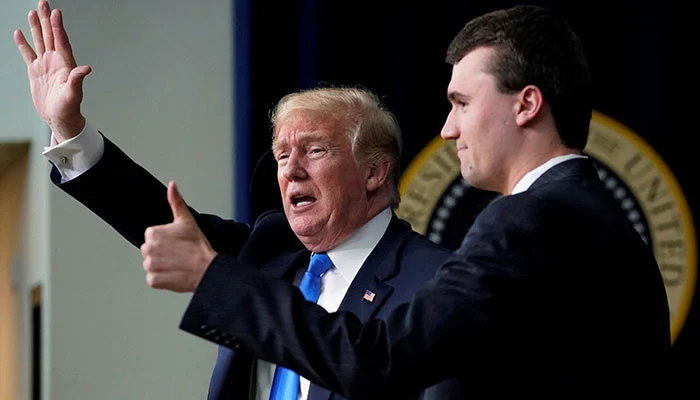
Since the shooting death of conservative activist Charlie Kirk, President Donald Trump has taken on an extraordinary role as a spokesperson. Trump was the first to confirm Kirk’s death to the nation, and the first to announce that the latest suspect was in custody. He also shared details about Kirk’s funeral and promised to attend.
Before a suspect was even detained, Trump, without evidence, blamed the “radical left” for Kirk’s murder. Many of his followers echoed the accusation, calling for vengeance amid a wave of right-wing anger. Kirk, a popular but divisive podcast host and author, was gunned down on a college campus in Utah where he was scheduled to speak, leaving behind a wife, friends, and countless followers.
However, it is Trump who has adopted a central role in shaping the narrative after his political ally’s death, sharing information that would typically be released by law enforcement or local officials, not the nation’s top leader. His actions stand in stark contrast to the more cautious approach of past presidents. Yet, they are completely consistent with his preference for direct communication, challenging convention and inserting himself into domestic and international issues.
Trump’s Unique Communication Style
Mercedes Schlapp, a senior adviser to Trump during his first term, noted, “The one thing about Donald Trump is he is a very detailed individual.” She added, “Whether he is building the Rose Garden Club or we have this awful tragedy, he wants to be the one to break the news.” Trump ordered flags to be flown at half-staff, announced he would award Kirk the Presidential Medal of Freedom, and had his vice president accompany Kirk’s casket home on Air Force Two—all highly unusual honors for a political operative who never held office or served in the military.
Trump had a close personal and political relationship with Kirk, the co-founder and president of the conservative student group Turning Point USA, which Trump credits with helping him appeal to young voters. On Fox News, Trump said, “Charlie had a magic over the kids,” recalling how his teenage son Barron was captivated by the charismatic 31-year-old activist.
Kirk was also a fiercely partisan figure whose combative style and anti-immigrant rhetoric often put him at odds with others online and in public. His far-right views on abortion, civil rights, and gun control also drew strong reactions from the groups his comments targeted.
Political Violence and Narrative Control
Trump has called for a non-violent response from his supporters but has avoided reporters’ questions about how to unify the country during its most prolonged surge in political violence since the 1970s. Trump himself was the target of two assassination attempts last year. He downplayed extremism from the political right, telling reporters, “we just have to beat the hell out of them,” which fueled his supporters’ calls for political revenge against the “radical left.” Twenty-two-year-old Tyler Robinson of Utah was arrested for the shooting, but the motive remains unclear as investigators analyze messages engraved on four bullet casings. Experts have said the messages could refer to either left- or right-leaning groups.
Schlapp said that Trump, a former reality TV host, enjoys his unstructured interactions with the press and the platform that comes with the attention he receives. She noted that his communication approach has become more aggressive in his second term. “He just really wants to drive the news, and who is better to drive the news than Donald Trump? And his strategy has worked,” she said. “His administration is on offense from a media standpoint like nothing I’ve ever seen. We were getting hit all the time in the first term. It has allowed the president to define a narrative.”
Since the shooting, there have been no briefings from Trump’s aides. Staff often defer to the president on policy announcements, declining to “get in front of the president.” Trump’s spontaneous, off-the-cuff style runs the risk of influencing a law enforcement process or being contradicted later by a clearer picture of the facts. Yu Ouyang, a professor of political science at Purdue University Northwest, said, “Presidents typically don’t release breaking news like that. They know the impact that their words would have.”
Critics, including Senator Elizabeth Warren, have criticized Trump’s remarks, pointing out that liberal and Democratic figures have also been targets of political violence. Some commentators have contrasted Trump’s extensive messaging on Kirk with his more muted response to the assassination of Minnesota Democratic Representative Melissa Hortman earlier this year. In a video message, Trump said, “violence and murder are the tragic consequences of demonizing those with whom you disagree,” but then only called out the rhetoric of the left.
Denise Bostdorff, a communications professor who has studied presidential rhetoric, said that while Trump “is trying to console at times, a lot of his rhetoric has also been very much ramping up—blaming a particular group before we even know who has done this.” The White House did not respond to requests for comment. Trump’s staff, however, promotes the president’s accessibility, and many of his supporters appreciate his norm-busting, blunt communication style. Barry Bennett, a former Trump campaign adviser, said, “Ronald Reagan was an orator, but Donald Trump understands the speed of news and how to get a story out there.”
