

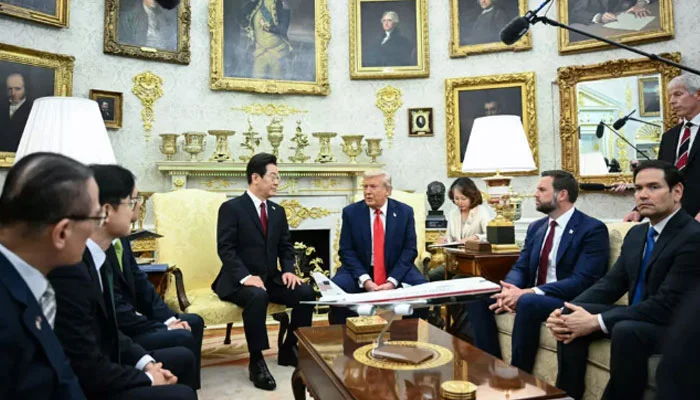
Donald Trump is trying to leave an architectural legacy unlike any American president in decades, with a gold-plated White House and a massive revamp planned for the capital, Washington D.C. The former real estate mogul, who famously declared, “I’m good at building things,” recently announced his biggest project yet: a new $200 million ballroom at the executive mansion.
Trump made his fortune by developing luxurious hotels and casinos bearing his name. Critics argue that the style of the White House makeover in his second presidency is very similar. Parts of it now resemble his ostentatious Mar-a-Lago resort in Florida, especially the newly paved Rose Garden with its picnic tables and signature yellow and white umbrellas.
During his first term, British style writer Peter York labeled Trump’s aesthetic “dictator chic,” drawing comparisons to the style of foreign autocrats. Beyond the White House, Trump has also recently unveiled a grand vision for the entire U.S. capital. He has explicitly linked his desire to “beautify” Washington to his recent crackdown on crime, which includes deploying troops in the Democratic-run city, where he had a military parade just two months ago for his birthday.
Peter Loge, director of George Washington University’s School of Media, told AFP that this is a “ratcheting up of the performance of power. That’s what he does. Puts his name on bibles and casinos, so the logic makes complete sense. Except now he’s playing with lives, the reputation of the United States and a democratic legacy.”
Oval Office’s Gilded Makeover
Trump is not the first president to undertake major renovations at the White House in its 225-year history. Franklin Roosevelt oversaw the construction of the current Oval Office in 1934, Harry Truman led a significant overhaul that finished in 1951, and John F. Kennedy created the modern Rose Garden in 1961.
The White House Historical Association put Trump’s changes in context, noting that the building is a “living symbol of American democracy, evolving while enduring as a national landmark.” Its president, Stewart McLaurin, wrote in a June essay that historical renovations have often faced criticism from the media and Congress over “costs, historical integrity and timing.” He added, “Yet many of these alterations have become integral to the identity of the White House, and it is difficult for us to imagine the White House today without these evolutions and additions.”
Nevertheless, Trump’s changes are the most extensive in nearly a century. Soon after his return, he began “blinging up” the Oval Office walls with gold trim and ornaments, which visiting foreign leaders have been careful to praise. He then ordered the famous grass of the Rose Garden to be replaced with a paved patio, explaining that women’s high-heeled shoes were sinking into the turf. After the project was completed, Trump installed a sound system, and AFP reporters could frequently hear music from his personal playlist blaring from the patio. Trump has also put two huge American flags on the White House lawns and a giant mirror on the West Wing colonnade, allowing the former reality TV star to see himself as he leaves the Oval Office.
‘Big Beautiful Face’
Billionaire Trump says he is personally funding these specific improvements. However, his bigger plans will require outside assistance. The White House stated that the new ballroom planned for the East Wing by the end of his term in January 2029 will be funded by “Trump and other patriotic donors.”
Meanwhile, Trump says he expects Congress to approve the $2 billion bill for his grand plan to beautify Washington. On a trip to oil-rich Saudi Arabia in May, Trump admired the “gleaming marvels” of the skyline and now appears determined to create his own gleaming capital. His plans range from a marble-plated makeover at the Kennedy Center for the Performing Arts to removing graffiti and, in true construction boss style, fixing broken road barriers and laying new asphalt.
Trump’s Washington plans also involve a crackdown by the National Guard, which he has threatened to extend to other cities like Chicago. He has repeatedly said of the troop presence that Americans would “maybe like a dictator”—even as he rejects his opponents’ claims that he is acting like one. Trump’s own face also looms over Washington’s streets on huge posters at the Labor and Agriculture departments. “Mr. President, I invite you to see your big beautiful face on a banner in front of the Department of Labor,” Labor Secretary Lori Chavez-DeRemer said at a cabinet meeting on Tuesday.
