

Islamabad, Pakistan
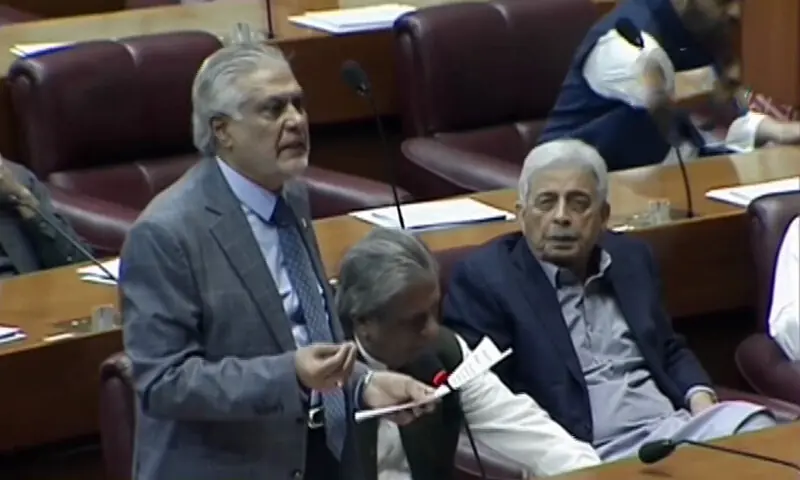
Pakistan’s Foreign Minister Ishaq Dar took to the floor of the National Assembly to offer a detailed and rare glimpse into the intense, discreet diplomatic efforts by eight Muslim and Arab nations to alter the US-led plan for ending the Israeli offensive in Gaza. While confirming that the final 20-point plan announced by US President Trump was not the original draft, he stressed that the complex, high-stakes negotiations represented the only viable path to halting the bloodshed.
“I made it clear that the 20 points that President Trump made public are not ours. Changes were made to our draft. I have the record,” Dar asserted, referencing his earlier press briefing. He quickly added, however, that with the plan now made public, “This is the end result, and there is no room for politicking.”
The plan emerged following a critical meeting between US President Donald Trump and eight countries—Jordan, United Arab Emirates, Indonesia, Pakistan, Türkiye, Saudi Arabia, Qatar, and Egypt—on the sidelines of the 80th United Nations General Assembly (UNGA) session. The core agenda was exclusively focused on finding a resolution to the ongoing Israeli onslaught in Gaza.
The Counter-Drafting Process
Dar revealed that before the main meeting, the foreign ministers of the eight nations held a preparatory session in New York to align their position on Gaza. He noted that President Trump responded positively, assuring them his team would work with the ministers to find a “workable solution” and that he would urge Israeli Prime Minister Benjamin Netanyahu to stop the bombardment.
The meetings, which Dar said were convened by the Qatari embassy and kept strictly “discreet,” saw the US side present its initial 20-point proposal.
“Instead of making a completely new draft, we decided to remain within this framework and decided to either amend or delete points based on our wish list,” Dar explained. For the next 24 hours, the ministers worked tirelessly, exchanging “hard copies in hotel rooms” to formulate a united “counter draft” which was then sent to the US side.
Upon the plan’s public announcement following Trump’s meeting with Netanyahu, Dar contacted the Saudi Foreign Minister. He was informed that the most urgent points put forth by the eight Muslim countries had been accepted, though further engagement was still needed on other aspects. The choice at that critical juncture, the Saudi minister suggested, was either to continue arguing while Israel continued its “bloodshed” or to accept the implementation of Trump’s plan and issue a joint statement.
“I said you are right, we should do this,” Dar affirmed, highlighting that with all other international forums having failed to stop the bombardment, this compromise was the only practical way forward. He proceeded to read out the joint statement issued on September 29, reiterating that “Statements will not suffice. We need practical work.”
Pakistan’s Unwavering Palestine Policy
The Foreign Minister also took the opportunity to reaffirm that Pakistan’s policy on Palestine remains consistent with that of its founder, Quaid-i-Azam Mohammad Ali Jinnah. “There has not been any change nor will there ever be,” he declared, restating Pakistan’s firm demand for an independent and sovereign Palestinian state with Al Quds Al Sharif as its capital.
Efforts to Free Flotilla Activists
Addressing another sensitive issue, Dar confirmed reports of Israel’s interception of the Global Sumud Flotilla (GSF), noting that former Jamaat-i-Islami senator Mushtaq Ahmad Khan was believed to be among the detained activists.
He informed the Assembly that Pakistan had enlisted the help of an “influential” third European country to secure the ex-senator’s release. Without naming the country, Dar assured that the foreign ministry was actively working to retrieve all Pakistanis involved in the flotilla, with definitive information expected by Sunday.
