

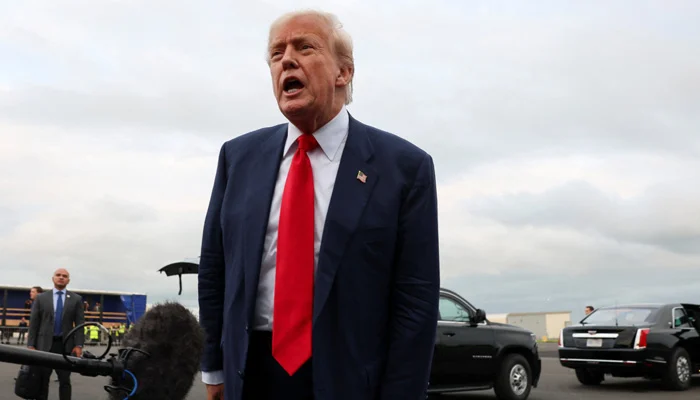
United States President Donald Trump announced on Saturday that the leaders of Cambodia and Thailand have agreed to an immediate meeting to swiftly negotiate a ceasefire, as he intervened to mediate peace following three days of intense fighting along their shared border. In a series of social media posts during his visit to Scotland, Trump stated he had conversed with Cambodian Prime Minister Hun Manet and Thailand’s acting Prime Minister Phumtham Wechayachai, and issued a warning that he would halt trade agreements with both Southeast Asian governments if the border conflict persisted.
“Both Parties are looking for an immediate Ceasefire and Peace,” Trump wrote, providing a detailed account of his diplomatic endeavors. Prior to Trump’s direct involvement with the two leaders, clashes on the Thai-Cambodian border had continued for a third day, with new flashpoints emerging on Saturday. Both sides maintained they had acted in self-defense in the border dispute and urged the other to cease hostilities and initiate negotiations. The renewed fighting has tragically resulted in over 30 fatalities and displaced more than 130,000 individuals, making it the most severe conflict between the two Southeast Asian neighbors in 13 years.
Early Saturday, both nations reported clashes in the neighboring Thai coastal province of Trat and Cambodia’s Pursat Province, marking a new front over 100 kilometers (60 miles) from other established conflict points along the long-contested border. Tensions initially escalated following the killing of a Cambodian soldier in a brief skirmish in late May. Troops on both sides were subsequently reinforced, leading to a full-blown diplomatic crisis that brought Thailand’s fragile coalition government to the brink of collapse. As of Saturday, Thailand reported seven soldiers and 13 civilians killed in the clashes, while Cambodia’s Defence Ministry spokesperson Maly Socheata stated that five soldiers and eight civilians had died on their side.
Following calls for restraint from Trump’s senior aides, the US President became directly involved on Saturday, engaging with each leader individually and relaying messages between them. “They have agreed to immediately meet and quickly work out a Ceasefire and, ultimately, PEACE!” Trump posted, adding that both countries were keen to return to the “Trading Table.” Trump has been seeking to finalize separate trade deals with dozens of countries in response to his announcement of wide-ranging tariffs on US imports. “When all is done, and Peace is at hand, I look forward to concluding our Trading Agreements with both!” Trump concluded, without providing further details on the ceasefire negotiations he said Thailand and Cambodia had agreed to hold. The Thai and Cambodian embassies in Washington did not immediately respond to requests for comment.
In the Thai border province of Sisaket, a university compound has been repurposed as temporary accommodation, currently housing over 5,000 displaced individuals, according to a volunteer. Samrong Khamduang, 51, recounted leaving her farm, approximately 10km from the border, when fighting erupted on Thursday. Her husband remained behind to care for their livestock. “We got so scared with the sound of artillery,” she said. “But my husband stayed back, and now we lost the connection. I couldn’t call him. I don’t know what is happening back there.”
In Kuala Lumpur, Malaysian Prime Minister Anwar Ibrahim, the current chair of the ASEAN regional bloc, affirmed his commitment to advancing a ceasefire proposal. Cambodia has endorsed Anwar’s plan, while Thailand has indicated its agreement in principle. “There is still some exchange of fire,” Anwar stated, as quoted by state news agency Bernama. He added that he had instructed his foreign minister “to liaise with the respective foreign ministries and, if possible, I will continue engaging with them myself – at least to halt the fighting.”
UN Security Council Meeting and Accusations
Thailand’s ambassador to the United Nations informed a Security Council meeting on Friday that Thai soldiers had been injured by newly planted landmines in Thai territory on two occasions since mid-July – claims Cambodia has vehemently denied. The ambassador also asserted that Cambodia had launched attacks on Thursday morning. “Thailand urges Cambodia to immediately cease all hostilities and acts of aggression, and resume dialogue in good faith,” Cherdchai Chaivaivid told the council in remarks released to the media.
Cambodia’s defense ministry, conversely, stated that Thailand had launched “a deliberate, unprovoked, and unlawful military attack” and was mobilizing troops and military equipment on the border. “These deliberate military preparations reveal Thailand’s intent to expand its aggression and further violate Cambodia’s sovereignty,” the ministry said in a statement on Saturday. Cambodia urged the international community to “condemn Thailand’s aggression in the strongest terms” and to prevent an expansion of its military activities, while Bangkok reiterated its preference for a bilateral resolution to the dispute.
Thailand and Cambodia have a decades-long history of disagreements over the jurisdiction of various undemarcated points along their 817-km (508-mile) land border. The ownership of the ancient Hindu temples Ta Moan Thom and the 11th-century Preah Vihear remains central to these disputes. While the International Court of Justice awarded Preah Vihear to Cambodia in 1962, tensions escalated in 2008 after Cambodia sought to list it as a UNESCO World Heritage site. This led to skirmishes over several years, resulting in at least a dozen fatalities. Cambodia stated in June that it had approached the court again to resolve its disputes with Thailand, which maintains it has never recognized the court’s jurisdiction and prefers a bilateral approach.
