

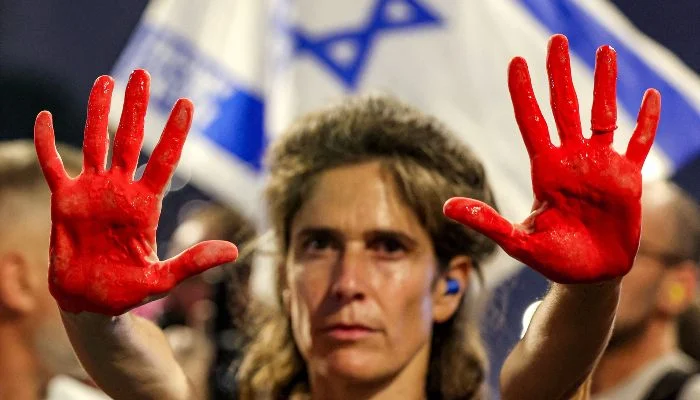
Now in its twenty-second month, Israel’s war in Gaza is setting friends and families against one another and intensifying existing political and cultural divides. On one side, families of hostages and peace activists are demanding that Prime Minister Benjamin Netanyahu’s government secure a ceasefire with Hamas to free the remaining captives. On the other side, right-wing members of Netanyahu’s cabinet want to take advantage of the moment to occupy and annex more Palestinian land, even at the risk of further international condemnation.
This heated debate has divided the nation and strained personal relationships, undermining national unity at a time of critical need during Israel’s longest war. “As the war continues we become more and more divided,” said Emanuel Yitzchak Levi, a 29-year-old poet and teacher from Israel’s religious left, who attended a peace gathering in Tel Aviv. “It’s really hard to keep being a friend, or a good son, a good brother to someone that’s — from your point of view — supporting crimes against humanity,” he told AFP. He added that it’s also difficult for his opponents to support him if they believe he has “betrayed my own country.” A dark-haired cyclist underscored this point by shouting “traitors” at the gathering, accusing the activists of playing into Hamas’s hands.
No Flowers
Dvir Berko, a 36-year-old worker at an IT startup, offered a more measured critique of the peace activists’ call for a ceasefire. He and others accused international organizations of exaggerating the threat of starvation in Gaza and told AFP that Israel should withhold aid until the remaining 49 hostages are freed. “The Palestinian people, they’re controlled by Hamas. Hamas takes their food. Hamas starts this war and, in every war that happens, bad things are going to happen. You’re not going to send the other side flowers,” he argued. He concluded that if they “open a war, they should realise and understand what’s going to happen after they open the war.”
Meron Rapoport, an independent journalist, noted that the raised voices in Tel Aviv reflect a deepening polarization that began after Hamas’s October 2023 attacks, which killed 1,219 people. Rapoport, a former senior editor at the liberal daily Haaretz, pointed out that while the attacks initially triggered a wave of national unity, the prolonged conflict and growing international criticism have hardened and diverged attitudes on both the right and left.
Political Motives
“The moment Hamas acted there was a coming together,” Rapoport said. “Nearly everyone saw it as a just war.” He added, “As the war went on it has made people come to the conclusion that the central motivations are not military reasons but political ones.” A survey conducted in late July by the Institute for National Security Studies found that Israelis narrowly blame Hamas for the delay in a hostage deal. Only 24% of Israeli Jews are distressed by the humanitarian situation in Gaza, where, according to UN-mandated reports, “a famine is unfolding.”
However, there is strong support for the families of the hostages, many of whom have accused Netanyahu of artificially prolonging the war to strengthen his political standing. Mika Almog, 50, an author and peace activist with the It’s Time Coalition, said: “These soldiers are our children and they are being sent to die in a false criminal war that is still going on for nothing other than political reasons.” In an open letter published on Monday, 550 former top diplomats, military officers, and spy chiefs urged US President Donald Trump to tell Netanyahu that the military phase of the war was already won and that he must now focus on a hostage deal. “At first this war was a just war, a defensive war, but when we achieved all military objectives, this war ceased to be a just war,” said Ami Ayalon, former director of the Shin Bet security service. He warned that the conflict “is leading the State of Israel to lose its security and identity.”
This declaration by security officers, who until recently oversaw Israel’s wars, mirrored the views of veteran peace activists who have long protested against them. Avi Ofer, a 70-year-old biblical archaeologist and kibbutz resident, has long campaigned for peace. He and fellow activists wore yellow ribbons with “667” written on them, marking the number of days the war has lasted. The historian was close to tears as he told AFP: “This is the most awful period in my life.” He acknowledged, “Yes, Hamas are war criminals. We know what they do. The war was justified at first. At the beginning it was not a genocide.” While few Israelis use the term “genocide,” many are aware that the International Court of Justice (ICJ) is considering a complaint that the country has violated the Genocide Convention. Many are also concerned that Israel might become an international pariah and that their conscripted sons and daughters could be treated as war crimes suspects abroad. Israel and Netanyahu, with support from the United States, have denounced the case in The Hague.
