

Manila, Philippines
The death toll from the powerful 6.9-magnitude earthquake that struck the central Philippines has climbed to 69, a disaster official confirmed on Wednesday, as the government mobilised agencies to search for survivors and restore critical power and water supplies to affected regions.
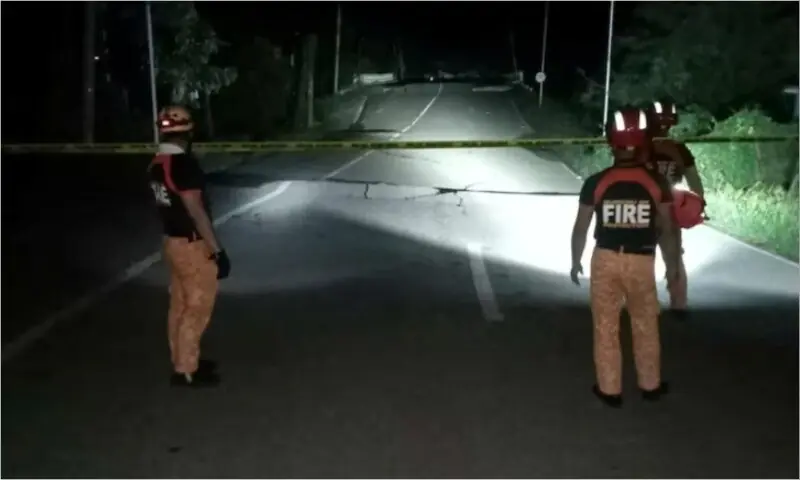
The shallow quake, which struck off the coast just before 10 pm on Tuesday, caused widespread damage. In Bogo city in the north of Cebu province, which was near the epicentre, the main hospital has been “overwhelmed,” Civil Defence official Raffy Alejandro told reporters, underscoring the severity of the crisis.
The reported toll of 69, based on data from the Cebu provincial disaster office, is subject to validation, according to Jane Abapo, an information officer at the regional Civil Defence office. Initial reports suggest more than 150 people were injured.
President Ferdinand Marcos Jr. offered swift assurances of assistance to survivors, confirming that cabinet secretaries were already on the ground directing relief operations, and he extended his condolences to those who lost loved ones.
Cebu, one of the Philippines’ most popular tourist destinations, is home to 3.4 million people. Despite the destruction, Mactan-Cebu International Airport, the country’s second busiest gateway, remains operational, providing a crucial logistical lifeline.
The hard-hit town of San Remigio was placed under a state of calamity to expedite the response and relief efforts. Vice Mayor Alfie Reynes issued an urgent appeal for food and water for evacuees, as well as heavy equipment to assist search and rescue workers battling the adverse conditions.
“It is raining heavily and there is no electricity, so we really need help, especially in the northern part because there’s a scarcity of water after supply lines were damaged by the earthquake,” Reynes told DZMM radio.
In the nearby town of Pilar, resident Archel Coraza recounted the moment the earth violently shook: “I woke them up and we all rushed outside into the street,” he told DZMM, noting that most of his family were asleep when the tremors hit. Coraza, who lives close to the shoreline, reported seeing the seawater recede following the initial tremor.
Local media broadcast devastating videos of people rushing out of their homes amidst shaking ground and collapsing structures, including a church that was more than a century old. Reynes confirmed that some of the deceased were playing basketball in a sports complex in San Remigio when it partially collapsed due to the quake.
Earthquake monitoring agencies placed the quake’s depth at only around 10km and recorded multiple aftershocks, the strongest measuring a magnitude of 6. Critically, there was no tsunami threat following the seismic event. The Philippines is located on the seismically active Pacific “Ring of Fire,” where volcanic activity and earthquakes are frequent occurrences.
