

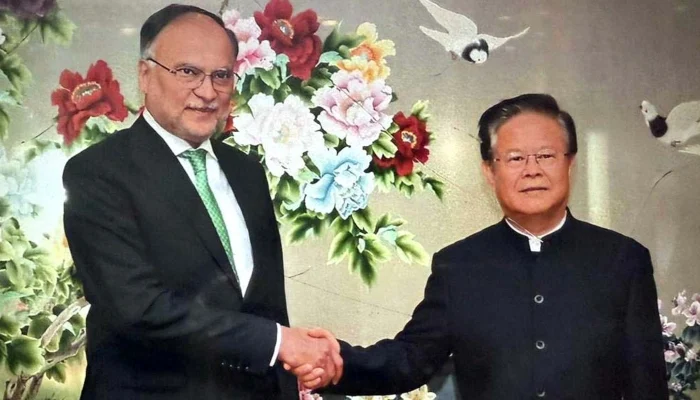
The 14th Joint Cooperation Committee (JCC) of the China-Pakistan Economic Corridor (CPEC) wrapped up in Beijing on Friday, marking a significant transition to CPEC Phase-II, yet failing to achieve a breakthrough on the long-standing issue of capacity payments owed to Chinese Independent Power Producers (IPPs).
Federal Minister for Planning and Development, Ahsan Iqbal, declared the meeting a milestone that formally initiated Phase-II. He stated: “Together, these priorities will transform CPEC into a corridor of industrialisation, technology, sustainability, and shared prosperity.”
The Phase-II agenda is anchored in the September 2025 action plan aimed at building a closer China-Pakistan community with a shared future. It outlines a broad framework focusing on industrial cooperation, Special Economic Zones (SEZs), agricultural modernisation, maritime development, and mining. Crucially, it continues to prioritise flagship connectivity projects such as the ML-1 railway modernisation, Karakoram Highway (KKH) realignment, and the ongoing development of Gwadar.
However, sources confirmed that the Chinese IPPs issue remained unresolved, primarily because Islamabad sought to extend the repayment period. Furthermore, regarding the partial financing of the ML-1 project, China is requesting a firm commitment from Islamabad before finalising the financing agreement, given the context of Pakistan’s ongoing IMF programme.
In his closing remarks, Minister Ahsan Iqbal highlighted the shared vision, renewed determination, and ambitious roadmap set for the next stage of this transformative initiative. Addressing Vice Chairman of the National Development and Reform Commission (NDRC) Zhou Haibing and the delegates, the Minister emphasised that the 14th JCC was not merely a review of past achievements but a reaffirmation of the collective resolve to deepen cooperation and forge a future of shared prosperity.
Highlighting the forward momentum, the Minister noted that CPEC Phase-II will be driven by five corridors of growth, innovation, green development, livelihood, and regional connectivity. These will align with Pakistan’s URAAN 5Es framework: Exports, E-Pakistan, Energy & Environment, and Equity & Empowerment. Minister Iqbal stressed the critical urgency of implementing the ML-1 and KKH realignment projects, noting their strategic importance for seamless connectivity between Pakistan and China, and predicting far-reaching economic dividends for the entire region upon their early execution.
To sustain this momentum, he proposed institutional strengthening: holding JCC meetings every six months and convening Joint Working Groups (JWGs) quarterly during the initial three years of Phase-II.
Acknowledging geopolitical challenges and propaganda by anti-CPEC forces, the Minister urged swift agreement on the JCC minutes to project a strong signal of unity and decisiveness. He announced that Pakistan and China have agreed to publish an updated CPEC long-term plan within 90 days, reflecting the synergy between Pakistan’s 5Es and the five corridors of CPEC 2.0.
Reassuring Chinese partners, Ahsan Iqbal reaffirmed Pakistan’s unwavering commitment to the safety and security of all CPEC projects and every Chinese national working in Pakistan. He described CPEC not just as a development initiative but as a symbol of the iron-clad friendship between the two nations, grounded in trust, stability, and mutual respect.
“CPEC is about making China and Pakistan not only all-weather friends, but also partners in high-quality development and innovation for the 21st century,” he asserted. He concluded by proposing that the 15th JCC meeting be held in May 2026 in Islamabad, coinciding with the 75th anniversary of diplomatic relations between Pakistan and China, further cementing their historic ties.
